How Much Does a Conservatory Cost? [2026 Guide]
Last updated: 21 September 2026
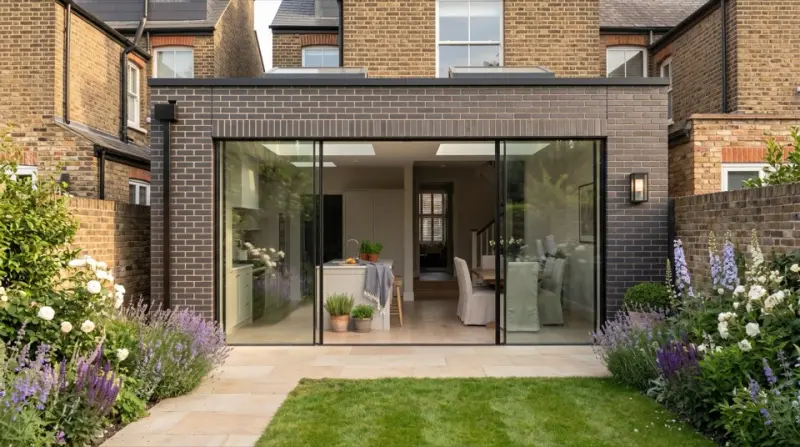
See it for your own home: put in your address and get free concept drawings and an indicative price. Get my free concept → Or see our Home Renovation →
A conservatory remains one of the most popular ways to add light, space, and value to a UK home. In 2026, a typical conservatory costs between £1,200 and £2,000 per square metre, according to data from the HomeOwners Alliance. For a standard 3m × 3m conservatory (9 m²), that means a total project cost of £10,800 to £18,000 — rising to £24,000 to £40,000 for a larger 4m × 5m (20 m²) build.
If you are considering an orangery — a more substantial structure with a solid roof and brick walls — expect to pay £2,000 to £3,000 per square metre, bringing a 15 m² orangery to roughly £30,000 to £45,000.
At Suddeco Homes, we help homeowners visualise their conservatory before they commit. Our platform reads your address, analyses nearby approved planning applications, and generates an instant render of your new conservatory or orangery — complete with concept plans and a priced design. Get your free render today.
Table of Contents
- Conservatory Cost Per Square Metre (2026)
- Complete Cost Breakdown Table
- Conservatory vs. Orangery: What's the Difference in Cost?
- Location-Specific Pricing
- What Affects the Cost of a Conservatory?
- How to Save Money on Your Conservatory
- Do You Need Planning Permission for a Conservatory?
- Conservatory vs. Extension: Which Costs More?
- How Suddeco Helps You Plan With Confidence
- Frequently Asked Questions
- Get Your Free Conservatory Render
Conservatory Cost Per Square Metre (2026)
The per-square-metre rate is the best way to benchmark conservatory costs. In 2026, UK conservatory pricing breaks down as follows:
| Quality Level | Cost per m² | Small (9 m²) | Medium (15 m²) | Large (20 m²) |
|---|---|---|---|---|
| Budget (uPVC, polycarbonate) | £1,200 – £1,500 | £10,800 – £13,500 | £18,000 – £22,500 | £24,000 – £30,000 |
| Mid-range (uPVC/aluminium, glass) | £1,500 – £1,800 | £13,500 – £16,200 | £22,500 – £27,000 | £30,000 – £36,000 |
| High-end (aluminium, solid roof, bi-folds) | £1,800 – £2,000 | £16,200 – £18,000 | £27,000 – £30,000 | £36,000 – £40,000 |
Sources: HomeOwners Alliance; indicative Suddeco estimates
These figures cover the conservatory structure, glazing, roof, doors, and basic foundations. They do not include connecting the conservatory to existing utilities, flooring, heating, or internal finishing. Adding underfloor heating, a tiled floor, or connecting the space to your central heating system will push costs toward the upper end.
Complete Cost Breakdown Table
A conservatory project involves more than just the structure itself. Below is a full cost breakdown for 2026:
| Cost Item | Low | Average | High | Notes |
|---|---|---|---|---|
| Conservatory structure (per m²) | £1,200 | £1,600 | £2,000 | Frame, glazing, roof, doors |
| Orangery structure (per m²) | £2,000 | £2,500 | £3,000 | Brick pillars, solid roof, lantern |
| Foundations and base | £1,500 | £3,000 | £5,000 | Concrete pad or dwarf wall; varies with soil |
| Planning permission (householder) | £0 | £206 | £462 | PD usually applies; full app only if needed |
| Building regulations | £0 | £300 | £800 | Only if >30 m² or separate heating system |
| Structural engineer | £500 | £1,000 | £2,000 | Required if removing walls or for complex roofs |
| Architect / Designer (optional) | £1,500 | £3,000 | £5,000 | 5–10% of build cost for bespoke designs |
| Party wall surveyor | £700 | £1,200 | £2,000 | Only if adjoining a neighbour's wall |
| Electrical work | £500 | £1,000 | £1,500 | Lighting, sockets, possible consumer unit upgrade |
| Heating extension | £500 | £1,500 | £3,000 | Underfloor heating or extending central heating |
| Flooring | £500 | £1,500 | £3,000 | Tiles, laminate, or engineered wood |
| Blinds / shading | £300 | £800 | £1,500 | Essential for temperature control in summer |
| Contingency (10–15%) | £1,500 | £3,000 | £5,000 | Essential buffer for unexpected issues |
| Total Typical Conservatory (15 m²) | £18,000 | £28,000 | £38,000 | Mid-range uPVC with glass roof |
| Total Typical Orangery (15 m²) | £30,000 | £40,000 | £52,000 | Mid-range aluminium, solid roof |
Note: Costs assume a straightforward rear- or side-facing build with good access. Complex sites, poor ground conditions, or conservation area restrictions may increase costs.
Conservatory vs. Orangery: What's the Difference in Cost?
The terms are often used interchangeably, but they represent two very different price points:
| Feature | Conservatory | Orangery |
|---|---|---|
| Wall construction | 75%+ glazing | Substantial brick pillars with glazing above |
| Roof | Glass or polycarbonate | Solid roof with roof lantern |
| Cost per m² | £1,200 – £2,000 | £2,000 – £3,000 |
| 15 m² total | £18,000 – £30,000 | £30,000 – £45,000 |
| Thermal performance | Good (with modern glazing) | Excellent |
| Planning complexity | Usually PD | May require full planning |
| Best for | Sun room, garden room, playroom | Kitchen extension, dining room, living space |
An orangery is essentially a light-filled extension. It feels more like a permanent room than a conservatory, holds heat better in winter, and stays cooler in summer. It also typically adds more value to your property — but costs roughly 50–60% more than a conservatory of the same size.
Location-Specific Pricing
Conservatory and orangery costs vary significantly by region, driven by labour rates, material transport costs, and local demand.
London
- Premium: +30–50% on base costs
- Conservatory (15 m²): £23,400 – £45,000
- Orangery (15 m²): £39,000 – £67,500
- London's high labour costs, congestion charges, and restricted site access make it the most expensive region. Premiums are highest in central boroughs and conservation areas.
South East (Surrey, Kent, Buckinghamshire, Hampshire)
- Premium: +20–30% on base costs
- Conservatory (15 m²): £21,600 – £39,000
- Orangery (15 m²): £36,000 – £58,500
- Strong demand for garden rooms and high local builder rates push prices above the national average.
Midlands (Birmingham, Nottingham, Leicester)
- Discount: Base to -10% on base costs
- Conservatory (15 m²): £18,000 – £33,000
- Orangery (15 m²): £30,000 – £49,500
- Competitive conservatory market and good builder availability keep costs reasonable.
North West & Yorkshire (Manchester, Leeds, Sheffield)
- Discount: -10–15% on base costs
- Conservatory (15 m²): £16,200 – £30,000
- Orangery (15 m²): £27,000 – £45,000
- Lower overheads and competitive installer market make this region good value.
Scotland (Glasgow, Edinburgh, Aberdeen)
- Discount: -10–20% on base costs
- Conservatory (15 m²): £15,300 – £30,000
- Orangery (15 m²): £25,500 – £45,000
- Outside Edinburgh's premium postcodes, Scotland offers some of the best conservatory value in the UK. However, harsher winters make solid-roof orangeries more popular — and more expensive.
Wales & South West
- Discount: Base to -10% on base costs
- Conservatory (15 m²): £18,000 – £33,000
- Orangery (15 m²): £30,000 – £49,500
- Rural areas may have higher transport costs for bespoke aluminium frames, but labour rates remain competitive.
What Affects the Cost of a Conservatory?
Several factors determine where your project falls within the £1,200–£2,000/m² range (or higher for orangeries).
1. Size and Shape
A simple rectangular conservatory is the cheapest to manufacture and install. Victorian and Edwardian styles with bay fronts, P-shapes, and T-shapes require more complex frames and glazing, adding 10–20% to costs. Larger conservatories benefit from slightly lower per-square-metre rates because fixed costs are spread over more area.
2. Frame Material
- uPVC: £1,200–£1,500/m². The most affordable option. Modern uPVC is durable and low-maintenance, though it lacks the slim sightlines of aluminium.
- Aluminium: £1,500–£2,000/m². Slimmer frames mean more glass and more light. Stronger and longer-lasting than uPVC, but more expensive.
- Timber: £2,000–£2,500/m². Rare for modern conservatories but required in some conservation areas. High maintenance but visually unmatched.
3. Roof Type
- Polycarbonate: £100–£150/m² for the roof. Lightweight and cheap, but noisy in rain and poor thermal performance.
- Glass: £200–£300/m² for the roof. Better insulation, UV protection, and sound reduction. Self-cleaning glass adds a premium.
- Solid / Tiled: £300–£500/m² for the roof. Best thermal performance, can match existing house roof tiles. Often used in orangeries.
- Hybrid (glass panels in solid roof): £250–£400/m². A compromise between light and insulation.
4. Glazing Specification
Standard double glazing is included in most quotes. Upgrading to triple glazing, solar control glass, or self-cleaning glass adds £50–£100 per m² of glazing but improves comfort and reduces long-term energy costs.
5. Foundations and Ground Conditions
A standard concrete foundation for a conservatory costs £1,500–£3,000. Poor soil, sloping ground, trees nearby (requiring deeper foundations), or the need to relocate drains can push this to £5,000+. A surveyor's report (£300–£600) is recommended before work begins.
6. Doors and Opening Mechanisms
Standard French doors are usually included. Upgrading to bi-fold doors adds £2,000–£5,000 depending on width and material. Sliding doors and lift-and-slide systems sit in between.
7. Heating, Electrics, and Flooring
Extending central heating, installing underfloor heating, or adding a new electrical circuit all add cost. A tiled floor with underfloor heating can add £3,000–£5,000 to a 15 m² conservatory but transforms it into a year-round usable space.
8. Blinds and Shading
Often overlooked in initial budgeting, blinds are essential for controlling temperature and glare. Budget £300–£1,500 depending on size and type (pleated, roller, roof blinds). Integrated roof blinds are the most expensive but most effective.
9. Access and Site Constraints
Restricted access, the need to remove existing structures, working around narrow side passages, or building on a sloped garden all increase labour costs by 10–25%.
How to Save Money on Your Conservatory
-
Choose a simple rectangular design — Victorian and Edwardian styles cost 10–20% more due to complex glazing and framing.
-
Opt for uPVC over aluminium — Modern uPVC is durable, thermally efficient, and significantly cheaper. Only choose aluminium if slim sightlines are essential.
-
Consider a warm roof retrofit — If you have an existing conservatory with a polycarbonate roof, a solid warm roof replacement (£4,000–£8,000) can transform it without rebuilding the whole structure.
-
Get multiple quotes — Conservatory prices vary significantly between installers. Obtain at least three detailed, written quotes and compare specifications carefully.
-
Use Suddeco's free render — Before committing to an installer, see what your conservatory could look like. Our platform generates a photorealistic render, cost estimate, and local planning context — free of charge.
-
Avoid peak season — Installers are busiest in spring and early summer. Booking for autumn or winter can secure discounts of 5–15%.
-
Negotiate on extras — Many installers include free or discounted upgrades (better glass, upgraded doors) as part of their sales process. Always ask.
-
Do your own groundwork — If you're competent, handling demolition of an existing structure, basic landscaping, or painting can save £500–£1,500.
Do You Need Planning Permission for a Conservatory?
Most conservatories fall under Permitted Development rights, provided they meet the following criteria: - No more than 50% of the original garden is covered by extensions (including the conservatory). - The conservatory is single-storey and no higher than 4 metres (or 3 metres if within 2 metres of the boundary). - The conservatory does not extend beyond the rear wall by more than 3 metres (semi-detached) or 4 metres (detached). - The property is not in a conservation area, AONB, or National Park with an Article 4 direction. - The building is not listed.
You must notify your local authority under the Neighbour Consultation Scheme if your conservatory extends 3–6 metres beyond the rear wall (semi-detached) or 4–8 metres (detached). This is not full planning permission but requires formal notification.
Building regulations do not normally apply to conservatories, provided: - The conservatory is separated from the house by external-quality walls, doors, or windows. - It has an independent heating system (or no heating). - The glazing meets safety standards.
If you want to remove the wall between your house and conservatory — creating an open-plan space — building regulations do apply, and you will need approval.
Conservatory vs. Extension: Which Costs More?
A conservatory is significantly cheaper than a traditional brick extension, but the gap narrows if you choose a high-end orangery with a solid roof, underfloor heating, and bi-fold doors.
| Factor | Conservatory | Rear Extension |
|---|---|---|
| Cost per m² | £1,200 – £2,000 | £1,800 – £2,800 |
| Planning permission | Usually PD | Often required |
| Building regulations | Often exempt | Always required |
| Build time | 2–4 weeks | 8–16 weeks |
| Disruption | Lower | Higher |
| Year-round use | Needs good heating/insulation | Naturally comfortable |
| Added value | 5–10% of home value | 15–25% of home value |
A conservatory is the most cost-effective way to add light and space. However, if you need a permanent, year-round room — especially a kitchen or dining space — a rear extension may be the better long-term investment despite the higher upfront cost. An orangery sits in the middle: more expensive than a conservatory, cheaper than a full extension, and more usable year-round.
How Suddeco Helps You Plan With Confidence
The biggest risk in any conservatory project is committing to a design before you can truly visualise it. Will it overwhelm the garden? Will it get enough light? What did the neighbours do?
Suddeco Homes removes the guesswork:
- Enter your address — Our platform reads your property, garden size, and orientation.
- See local precedents — We show you approved conservatories and extensions on nearby streets, so you know what's realistic in your area.
- Get an instant render — A photorealistic visual of your conservatory, generated by our platform.
- Receive a priced concept — Based on 2026 UK construction rates, we estimate your project cost with no guesswork.
- Upgrade when you're ready — Start with a free render, then choose our Concept Package (£495–£995) for full plans, or our Design+Planning Package (£2,495) for a complete planning application and building regs package.
Frequently Asked Questions
How much does a conservatory cost in 2026?
In 2026, a typical UK conservatory costs £1,200–£2,000 per square metre. A small 9 m² conservatory costs £10,800–£18,000, while a 20 m² conservatory ranges from £24,000–£40,000. Orangeries cost £2,000–£3,000 per square metre.
How much does an orangery cost in 2026?
An orangery costs £2,000–£3,000 per square metre in 2026. A 15 m² orangery typically costs £30,000–£45,000, rising to £40,000–£52,000 for high-end aluminium frames, solid roofs, and bi-fold doors.
Do I need planning permission for a conservatory?
Usually no. Most conservatories fall under Permitted Development rights, provided they meet size and height restrictions. However, if you live in a conservation area, AONB, or listed building, you may need full planning permission. Always check with your local planning authority.
How long does it take to build a conservatory?
A straightforward conservatory takes 2 to 4 weeks to install. An orangery or a build requiring complex foundations may take 4 to 8 weeks. Planning and building regulations (if required) add 4–8 weeks before work can begin.
Does a conservatory add value to my home?
Yes. According to the HomeOwners Alliance, a conservatory typically adds 5–10% to your home's value. An orangery adds more — 10–15% — because it feels like a permanent extension. The exact value depends on quality, size, and the local market.
Is a conservatory cheaper than an extension?
Yes, significantly. A conservatory costs roughly £1,200–£2,000 per square metre, while a brick extension costs £1,800–£2,800 per square metre. However, a conservatory is not always a year-round space unless you invest in heating and insulation. An orangery bridges the gap.
What is the cheapest type of conservatory?
A lean-to conservatory with a uPVC frame and polycarbonate roof is the cheapest option. Its simple rectangular shape and single-pitched roof require less material and labour than Victorian or Edwardian designs. A small lean-to (3m × 3m) can cost as little as £8,000–£10,000.
Can I use a conservatory all year round?
With modern glazing, a solid or hybrid roof, underfloor heating, and proper insulation, yes. Budget conservatories with polycarbonate roofs and no heating are often too hot in summer and too cold in winter. Investing in a warm roof and heating makes the space usable 365 days a year.
What is a warm roof conservatory?
A warm roof replaces the traditional glass or polycarbonate roof with an insulated, tiled, or solid roof. It dramatically improves thermal performance, reduces noise, and makes the conservatory feel like a permanent room. A warm roof retrofit costs £4,000–£8,000 and is one of the best-value upgrades for an existing conservatory.
Do I need building regulations for a conservatory?
Usually no, provided the conservatory is separated from the house by external walls, doors, or windows, and has an independent heating system (or no heating). If you want to remove the connecting wall and create an open-plan space, building regulations do apply.
How much does underfloor heating for a conservatory cost?
Electric underfloor heating for a 15 m² conservatory costs £1,000–£2,000 for the system plus installation. Wet (hydronic) underfloor heating connected to your central heating costs £2,000–£3,500 but is more efficient long-term.
Can I replace my conservatory roof?
Yes. A roof replacement is one of the most popular conservatory upgrades. Replacing a polycarbonate roof with glass costs £2,000–£4,000. Replacing it with a solid warm roof costs £4,000–£8,000. This single change can transform a conservatory's usability and energy efficiency.
How much does a conservatory cost in London?
In London, conservatory costs are 30–50% higher than the national average. A 15 m² conservatory typically costs £23,400–£45,000, while an orangery ranges from £39,000–£67,500. Central London boroughs and conservation areas push costs to the top end.
What is the best frame material for a conservatory?
- uPVC: Best value, low maintenance, good thermal performance. Ideal for most homeowners.
- Aluminium: Slim sightlines, more glass, stronger and longer-lasting. Best for modern designs and large spans.
- Timber: Required in some conservation areas. High maintenance but visually traditional.
Do I need a survey before building a conservatory?
Yes, a ground survey is highly recommended. It identifies soil type, drainage, and any potential foundation issues. A survey costs £300–£600 but can save thousands by avoiding unexpected groundwork costs.
Get Your Free Conservatory Render
Stop imagining and start visualising. Suddeco's free render tool uses your address to generate an instant photorealistic concept of your conservatory or orangery, complete with 2026 cost estimates and local planning precedents. No obligation, no credit card — just clarity.
Get your free conservatory render →
See it before you spend a penny
Get a free render of your finished project + a real price — in minutes.
Get your free concept →