House Renovation Cost per m²: The Complete 2026 UK Guide
Last reviewed: 8 October 2026
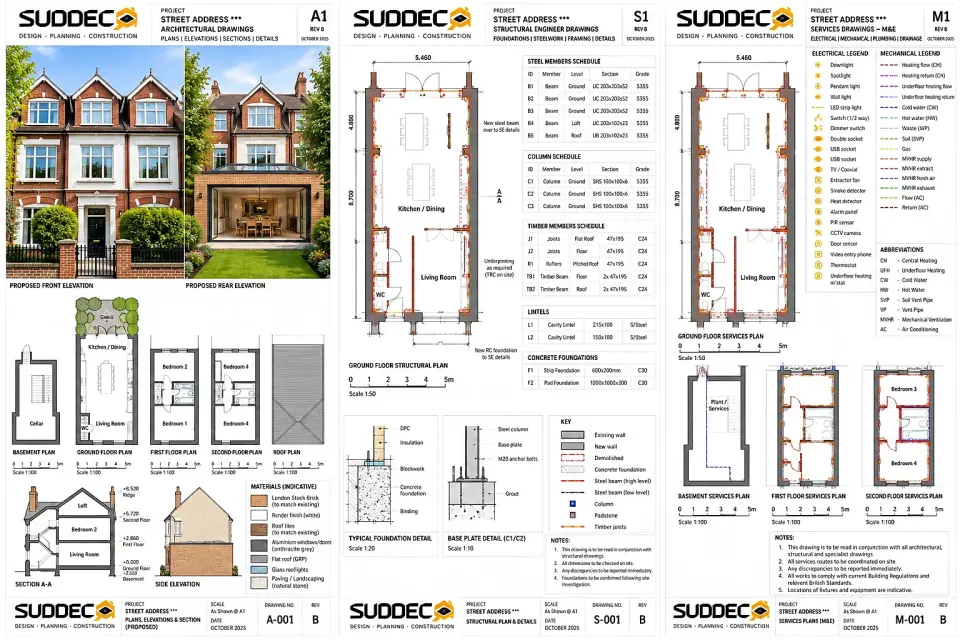
See it for your own home: start a project enquiry to discuss concept drawings and an indicative budget. Get my free concept → Or see our Home Renovation →
If you are pricing a whole-house renovation in 2026, the cost per square metre is the fastest way to sense-check your budget. Use it as an early comparison, then check the existing condition, proposed work and specification with your project team before committing to a budget.
For early budgeting, this guide uses an indicative range of £1,500 to £3,000 per square metre for a mid-range, full-gut renovation of a typical 3-bedroom property. Light cosmetic refreshes start at £800 per m², while high-end renovations with bespoke joinery, smart home integration, and underfloor heating throughout can reach £4,000–£6,000 per m². All figures include VAT at 20% on labour and materials unless stated otherwise.
This guide breaks down exactly what is included in that per-m² figure, how it shifts by renovation type, property size, and location, and how to calculate an accurate total for your specific home. The ranges are indicative planning estimates, not a quotation or a verified market average. For general homeowner guidance, see the HomeOwners Alliance; compare itemised quotes for your own property.
Table of Contents
- The Headline Figure: Cost per m² in 2026
- Cost per m² by Renovation Type
- Cost per m² by Property Size
- Regional Price Variations per m²
- What Is Included in the Per-m² Price?
- What Is NOT Included?
- Room-by-Room Cost Breakdown
- Factors That Increase Cost per m²
- How to Reduce Your Cost per m²
- Renovation vs. Extension vs. New Build per m²
- Getting an Accurate Quote
- Frequently Asked Questions
For a London whole-house renovation, note whether the brief changes the layout, moves services or updates finishes, and record the property's existing condition before comparing estimates. Clear inclusions make budgets easier to compare.
Suddeco Homes brings architecture, structural engineering, interior design, planning, construction and project management together for London renovation projects. Explore our home renovation services.
Plan your next step: book a free survey for your London property.
The Headline Figure: Cost per m² in 2026
The UK average for a mid-range whole-house renovation in 2026 sits at roughly £2,000 per m² of total floor area. Here is how that breaks across the renovation spectrum:
| Renovation Level | Cost per m² | Typical Total (100 m² house) | What You Get |
|---|---|---|---|
| Light Refresh | £800 – £1,500 | £80,000 – £150,000 | Redecoration, new flooring, basic kitchen and bathroom refresh, minor repairs, new sockets and light fittings |
| Medium Renovation | £1,500 – £2,500 | £150,000 – £250,000 | New kitchen, new bathrooms, partial rewiring, replastering, new doors, new boiler, upgraded windows |
| Full Gut Renovation | £2,500 – £4,000 | £250,000 – £400,000 | Back-to-brick strip-out, full rewiring and replumbing, new windows and doors throughout, new kitchen, new bathrooms, new flooring, full decoration, minor structural alterations |
| Premium Renovation | £4,000 – £6,000+ | £400,000 – £600,000+ | Everything in a full gut, plus bespoke joinery, underfloor heating throughout, smart home systems, air source heat pump, premium materials, architect-designed details |
These figures represent construction and fitting costs inclusive of VAT at 20%. They do not include professional fees, contingency, or furnishings. For a realistic total budget, add 15–20% on top to cover design, planning, structural engineering, and a contingency fund.
Indicative planning ranges; confirm the scope, fees, contingency and VAT with your project team.
Cost per m² by Renovation Type
The scope of your renovation is the single biggest driver of cost per m². Below is how each level compares, with a breakdown of what is typically included and what pushes the price higher.
Light Refresh (Cosmetic Renovation)
- Cost per m²: £800 – £1,500
- What it includes: Repainting walls and ceilings throughout, new carpet or engineered wood flooring, updating light fittings and sockets, refreshing the kitchen with new doors and worktops (not full replacement), re-tiling bathrooms, minor plaster repairs, new internal doors, basic garden tidy-up
- What it excludes: Structural work, rewiring, replumbing, window replacement, boiler replacement
- Best for: Properties in good structural condition where the layout works and the goal is modernisation rather than transformation
A light refresh assumes the existing electrics, plumbing, windows, and heating system are serviceable for another 10–15 years. It is the most cost-effective way to improve a property's appearance and saleability without heavy disruption.
Medium Renovation
- Cost per m²: £1,500 – £2,500
- What it includes: New fitted kitchen with standard appliances, new bathroom suites, partial or full rewiring if needed, replumbing with new boiler, replastering of most walls, new internal and external doors, upgraded windows (UPVC or basic aluminium), new flooring throughout, new skirting and architraves, full decoration
- What it excludes: Structural alterations, extensions, loft conversions, underpinning, bespoke joinery
- Best for: Properties built between 1960 and 2000 that need modernisation but are structurally sound
The medium renovation is the most common scope for UK homeowners in 2026. It delivers a fully modernised home without the cost and complexity of stripping back to brick. Most medium renovations take 8–16 weeks depending on property size.
Full Gut Renovation
- Cost per m²: £2,500 – £4,000
- What it includes: Complete strip-out to brick or blockwork, full rewiring with new consumer unit, full replumbing with new boiler and unvented cylinder, new windows and external doors throughout, new kitchen and bathrooms, new plasterboard and skim on all walls and ceilings, new flooring, new internal doors, ironmongery, full decoration, minor structural alterations (removing non-load-bearing walls, installing steels for open-plan layouts)
- What it excludes: Extensions, loft conversions, basement excavations, major structural work (underpinning, new foundations)
- Best for: Victorian and Edwardian properties, 1930s semis, or any home that has not been updated in 30+ years
Full gut renovations are labour-intensive and disruptive. Most homeowners move out for the duration. The per-m² cost is higher because every surface, system, and fixture is replaced. However, the result is essentially a new home inside an existing shell.
Premium Renovation
- Cost per m²: £4,000 – £6,000+
- What it includes: Everything in a full gut, plus: bespoke kitchen cabinetry, natural stone or composite worktops, Gaggenau or Miele appliances, underfloor heating throughout, air source heat pump or integrated MVHR, smart home lighting and heating controls, bespoke wardrobes and joinery, premium engineered oak or polished concrete flooring, Crittall-style or aluminium windows, architect-designed details, high-end bathroom fixtures, freestanding baths, walk-in showers with recessed niches
- Best for: High-value properties, design-led renovations, or homeowners planning to stay long-term
Premium renovations often involve an architect or interior designer from the outset. The per-m² cost reflects both material quality and the additional labour required for bespoke detailing.
Cost per m² by Property Size
The size of your property affects the cost per m² in a counter-intuitive way. Very small and very large properties both carry cost inefficiencies.
| Property Size | Typical Floor Area | Light Refresh | Medium Renovation | Full Gut | Premium |
|---|---|---|---|---|---|
| 1-bed flat | 40–55 m² | £32,000–£83,000 | £60,000–£138,000 | £100,000–£220,000 | £160,000–£330,000 |
| 2-bed flat/house | 60–80 m² | £48,000–£120,000 | £90,000–£200,000 | £150,000–£320,000 | £240,000–£480,000 |
| 3-bed house | 90–120 m² | £72,000–£180,000 | £135,000–£300,000 | £225,000–£480,000 | £360,000–£720,000 |
| 4-bed house | 130–170 m² | £104,000–£255,000 | £195,000–£425,000 | £325,000–£680,000 | £520,000–£1.02m |
| 5-bed house | 180–250 m² | £144,000–£375,000 | £270,000–£625,000 | £450,000–£1.0m | £720,000–£1.5m |
Why smaller properties have a higher per-m² cost:
A 50 m² two-bedroom flat still requires a full kitchen, a full bathroom, a new boiler, and a consumer unit — the same fixed costs as a 120 m² house. These fixed costs are spread over fewer square metres, pushing the per-m² rate higher. A new boiler installation costs £3,000–£5,000 whether you heat 50 m² or 150 m².
Why very large properties do not always see lower per-m² costs:
Above 200 m², renovation projects often include premium features — multiple bathrooms, bespoke kitchens, home offices, utility rooms, and landscaped gardens. These additions push the per-m² cost back up, even though the base construction rate might drop slightly.
Regional Price Variations per m²
Labour and material costs vary significantly across the UK. The table below shows the cost per m² for a mid-range full gut renovation by region in 2026.
| Region | Cost per m² (mid-range) | Premium vs. National Average |
|---|---|---|
| London (Zones 1–3) | £2,800–£4,500 | +30–50% |
| London (Outer) | £2,400–£3,800 | +20–30% |
| South East | £2,400–£3,800 | +20–30% |
| South West | £2,000–£3,200 | National average |
| East Anglia | £2,000–£3,000 | National average |
| East Midlands | £1,800–£2,800 | -5–10% |
| West Midlands | £1,800–£2,800 | -5–10% |
| North West | £1,600–£2,600 | -10–15% |
| North East | £1,500–£2,400 | -10–20% |
| Yorkshire & Humber | £1,600–£2,600 | -10–15% |
| Wales | £1,600–£2,600 | -10–15% |
| Scotland | £1,500–£2,500 | -10–20% |
| Northern Ireland | £1,500–£2,400 | -10–20% |
London
A full gut renovation of a 100 m² Victorian terrace in Clapham or Hackney typically costs £280,000–£450,000 including VAT. London's premium reflects higher labour rates, congestion and parking restrictions, limited access for skips and materials, and the prevalence of period properties requiring specialist trades (lime plastering, sash window restoration, heritage roofing).
South East England
Surrey, Berkshire, and Buckinghamshire sit just below London but still carry a 20–30% premium. The high concentration of affluent homeowners drives demand for premium finishes, and skilled trades are in short supply.
Midlands & North of England
Cities like Manchester, Birmingham, Leeds, and Sheffield benefit from a competitive builder market and lower living costs. A 100 m² full gut renovation in Manchester might cost £160,000–£260,000 compared to £250,000–£400,000 nationally.
Scotland & Wales
Scotland and Wales offer competitive pricing, but the building warrant and planning process differs. In Scotland, most substantial renovations require a building warrant, which adds £500–£1,500 in fees but does not significantly affect the construction cost per m². Wales has similar requirements through local authority building control.
Source: indicative Suddeco estimates
What Is Included in the Per-m² Price?
When a builder or renovator quotes £2,500 per m² for a full gut renovation, they usually mean the following is included:
- Strip-out: Removal of existing fixtures, fittings, flooring, plaster, and kitchen/bathroom units; disposal via skip
- Structural work: Removal of non-load-bearing walls, installation of steel beams for open-plan layouts, lintel replacements
- Electrics: Full rewiring, new consumer unit, new sockets, switches, light fittings, smoke and heat alarms, extractor fans
- Plumbing: Full replumbing, new boiler, new radiators or underfloor heating, hot and cold feeds, waste pipes, unvented cylinder if required
- Windows and external doors: Supply and installation of new double-glazed units and external doors
- Internal doors and ironmongery: New doors, handles, hinges, and locks throughout
- Plastering: Plasterboard and skim finish to all walls and ceilings (or lime plaster for period properties)
- Flooring: Subfloor preparation and supply of new floor finishes (carpet, engineered wood, tiles, or vinyl)
- Kitchen: Supply and installation of fitted kitchen units, worktops, and standard appliances (oven, hob, extractor, dishwasher)
- Bathrooms: Supply and installation of sanitaryware, tiling, taps, shower enclosures, and extraction
- Decoration: White emulsion walls and ceilings, undercoat and gloss on woodwork
- Scaffolding: External access where required for windows, roofing, or rendering
- Waste removal: Skip hire and disposal of construction waste
Always ask for a written schedule of works. Some renovators exclude scaffolding, waste removal, or kitchen appliances from their per-m² rate, which can add £5,000–£15,000 to the final bill.
What Is NOT Included?
The per-m² construction cost does not cover everything. Budget separately for:
| Item | Cost Range |
|---|---|
| Architect / design fees | 5–10% of build cost (£12,500–£40,000 on a £250k–£400k project) |
| Structural engineer | £500 – £2,500 |
| Planning application (if required) | £206 – £462 |
| Building regulations / building warrant | £200 – £1,500 |
| Party wall agreement | £700 – £2,000 per neighbour |
| Asbestos survey and removal | £500 – £3,000+ |
| Damp survey and treatment | £500 – £5,000 |
| Tree survey (if required) | £300 – £800 |
| Party wall surveyor | £700 – £2,000 |
| Underfloor heating (if not included) | £1,500 – £4,000 per zone |
| Smart home system | £2,000 – £10,000 |
| Air source heat pump | £8,000 – £15,000 |
| Bespoke joinery (wardrobes, storage, media units) | £5,000 – £20,000 |
| Window treatments (curtains, blinds, shutters) | £2,000 – £8,000 |
| Furniture and soft furnishings | £5,000 – £30,000+ |
| Contingency | 10–15% of total |
On a typical £250,000 full gut renovation, these extras can add £50,000–£100,000. That is why the total project cost is often 25–35% higher than the headline per-m² construction rate.
Note on VAT: The illustrative construction figures in this guide assume VAT at 20%. Most building work on houses and flats is subject to 20% VAT. Some qualifying conversions or renovations may attract 5%, while qualifying new homes may be zero-rated. Converting a commercial property into a dwelling does not automatically make the work zero-rated. Check the conditions and the treatment of each part of the work with your builder or accountant before committing. See GOV.UK guidance on VAT for builders.
Room-by-Room Cost Breakdown
Understanding where the money goes room by room helps you prioritise if your budget is tight. The figures below are for a full gut renovation of a typical 3-bedroom, 100 m² house.
| Room / Element | Typical Cost | % of Total |
|---|---|---|
| Kitchen (units, worktops, appliances, fitting) | £15,000 – £35,000 | 12–18% |
| Bathroom (suite, tiling, extraction) | £5,000 – £12,000 | 4–6% |
| En-suite or second bathroom | £4,000 – £10,000 | 3–5% |
| Downstairs WC | £2,000 – £4,000 | 1–2% |
| Electrics (full rewire) | £6,000 – £12,000 | 5–8% |
| Plumbing and heating (new boiler, radiators, pipework) | £8,000 – £15,000 | 6–10% |
| Windows and external doors (UPVC) | £8,000 – £18,000 | 6–12% |
| Internal doors and ironmongery | £2,000 – £5,000 | 1–3% |
| Plastering (all walls and ceilings) | £6,000 – £12,000 | 5–8% |
| Flooring (all rooms) | £5,000 – £12,000 | 4–6% |
| Decoration (all rooms) | £3,000 – £6,000 | 2–4% |
| Structural work (steels, lintels, minor alterations) | £3,000 – £8,000 | 2–5% |
| Strip-out and waste removal | £2,000 – £5,000 | 1–2% |
| Scaffolding and access | £1,500 – £4,000 | 1–2% |
| Subtotal (construction) | £70,500 – £168,000 | 100% |
For a 100 m² property, the room-by-room breakdown above aligns with a per-m² cost of £1,800–£2,500 for a medium renovation, or £2,500–£4,000 for a full gut with higher-spec kitchens and bathrooms.
Factors That Increase Cost per m²
Several property-specific and design factors push your project toward the upper end of the price range.
1. Age and Condition of the Property
Properties built before 1919 (Victorian and Edwardian) often require specialist trades: lime plaster instead of gypsum, sash window restoration, lead flashing, and heritage roofing. These can add 15–25% to the per-m² cost. Post-war properties (1945–1965) may contain asbestos, which requires licensed removal at £500–£3,000+.
2. Structural Issues
Subsidence, sagging floors, rotten joists, and failing lintels are common in older homes. Remedial structural work can add £5,000–£20,000 to the project. Underpinning — required for serious subsidence — can cost £10,000–£50,000 depending on the extent.
3. Damp and Timber Decay
Rising damp, penetrating damp, and dry rot are common in unrenovated properties. A full damp-proof course, tanking, and timber replacement can add £3,000–£10,000. Always commission a full building survey before buying a property to renovate.
4. Listed Buildings and Conservation Areas
For a listed property or one in a conservation area, check the applicable restrictions with your local planning authority before work starts. Requirements depend on the property and the proposed alterations. Specialist design, materials and approvals can affect the budget and programme.
5. Open-Plan Layouts
Removing load-bearing walls to create open-plan kitchens or through-lounges requires structural steel beams (RSJs or UB sections). A single steel installation costs £1,500–£3,000 including labour. Complex multi-steel configurations can reach £5,000–£10,000.
6. Underfloor Heating
Wet underfloor heating throughout a 100 m² house costs £8,000–£15,000 installed — roughly £80–£150 per m². It is more efficient than radiators but adds significantly to upfront cost. Electric mats are cheaper (£50–£100 per m²) but more expensive to run.
7. High Glazing Ratios
Large bi-fold doors, roof lanterns, and floor-to-ceiling windows add cost. A 3-metre set of aluminium bi-fold doors costs £3,000–£6,000. A large roof lantern adds £2,000–£5,000. These are often worth the investment for light and garden connection but push the per-m² rate up.
8. Access Constraints
Narrow streets, limited parking, or properties with no rear access increase scaffolding costs and make material deliveries harder. In central London and Brighton, some projects require crane hire for steel beams and skips, adding £1,500–£5,000.
How to Reduce Your Cost per m²
A lower cost per m² does not have to mean lower quality. Here are proven ways to control costs without cutting corners.
1. Prioritise High-Impact Rooms
If your budget is limited, focus on the kitchen, main bathroom, and living spaces. Bedrooms and hallways can be refreshed cosmetically for a fraction of the cost of a full gut. A strategic medium renovation of key rooms costs significantly less per m² than a whole-house strip-out.
2. Retain the Existing Layout
Moving kitchens, bathrooms, and soil stacks is expensive. Keeping the kitchen where it is, retaining the bathroom locations, and avoiding soil pipe relocations can save £5,000–£15,000 in plumbing costs. The same applies to electrics — retaining the consumer unit location avoids costly cable rerouting.
3. Phase the Work
If you cannot afford a full gut renovation upfront, phase it. Phase 1 might cover structural work, electrics, and plumbing. Phase 2 covers kitchens and bathrooms. Phase 3 covers decoration and flooring. Spreading costs over 12–24 months makes a large project more manageable.
4. Use Standard Materials
Bespoke handmade tiles, imported stone, and custom steelwork look impressive but inflate costs. Standard porcelain tiles, British-made bricks, and UK-supplied windows offer excellent performance at a lower price point. A Howdens or Wickes kitchen with quartz worktops delivers 90% of the functionality of a bespoke kitchen at 40% of the cost.
5. Get Multiple Quotes
We recommend three detailed quotes as a minimum. On a £250,000 renovation, the difference between the lowest and highest quote can be £50,000–£80,000. Ensure each quote is based on the same schedule of works so you are comparing like for like.
6. Check the Applicable VAT Rate
Most building work on houses and flats is subject to 20% VAT. Some qualifying conversions or renovations may attract 5%, while qualifying new homes may be zero-rated. Converting a commercial property into a dwelling does not automatically make the work zero-rated. Check the conditions and the treatment of each part of the work with your builder or accountant before committing.
7. Book in the Off-Season
Ask prospective contractors about availability and whether a flexible start date changes their quote. Compare the same scope and specification, and allow for weather-sensitive work. A particular season does not guarantee a discount.
8. Start with a Clear Project Brief
Start by recording your address, property type, rooms affected and the work you want to achieve. Use our concept drawings enquiry to discuss the next step. Concept drawings and early estimates help shape a brief; they do not replace a measured survey, structural advice or an itemised quote.
Renovation vs. Extension vs. New Build per m²
Homeowners often weigh a whole-house renovation against moving to a new home, building an extension, or demolishing and rebuilding. Here is how the per-m² costs compare.
| Project Type | Cost per m² | Total (100 m²) | Key Advantages |
|---|---|---|---|
| Light refresh | £800 – £1,500 | £80,000 – £150,000 | Lowest disruption; stay in the property; quick turnaround |
| Medium renovation | £1,500 – £2,500 | £150,000 – £250,000 | Modernises key systems; good resale value; mid-level disruption |
| Full gut renovation | £2,500 – £4,000 | £250,000 – £400,000 | Like a new home; retains existing footprint; no planning for internal work |
| Extension only | £1,800 – £2,800 | £36,000 – £56,000 (20 m²) | Adds space; often permitted development; focused disruption |
| New build | £2,000 – £3,500 | £200,000 – £350,000 | Full customisation; latest building regs; no legacy issues |
| Demolish and rebuild | £2,500 – £4,000 | £250,000 – £400,000 | New home on existing plot; retains garden and location; VAT zero-rated |
Key insight: A full gut renovation costs roughly the same per m² as a new build but avoids the cost of land acquisition. If you love your location and your plot, renovating or rebuilding is usually more cost-effective than buying a equivalent new home — particularly in high-value areas like London and the South East.
For a full cost breakdown of extension types, see our extension cost guide.
Getting an Accurate Quote
The per-m² figures in this guide are a solid starting point, but every property is unique. The most reliable way to budget is to get a detailed, itemised quote based on your specific home and condition.
Start with a clear brief, then agree the surveys, drawings and professional checks your project needs. Delivery dates depend on the scope and should be confirmed before you order.
How it works:
- Start your enquiry through our concept drawings page
- Tell us about the existing property, proposed work, priorities and budget
- Discuss the drawings, survey information and estimate appropriate to your brief
- Upgrade to our Concept Package (£495–£995); confirm the deliverables, revisions and delivery date before ordering
- Or choose Design + Planning for the full planning application, building regulations, and structural engineering (£2,495)
An early estimate is a starting point. Confirm scope, exclusions, approvals and programme with the project team before committing.
Get your free renovation cost estimate →
Frequently Asked Questions
What is a good cost per m² for a house renovation in the UK?
A reasonable benchmark in 2026 is £1,800–£2,500 per m² for a mid-range renovation of a typical 3-bedroom property. Light cosmetic refreshes start at £800/m², while full gut renovations with high-end finishes can reach £4,000–£6,000/m². (Indicative estimate)
Why do renovation costs vary so much per m²?
Variation comes from the property's age and condition, the scope of work, location, finish quality, and site access. A light refresh of a modern flat in Leeds costs far less per m² than a full gut renovation of a Victorian terrace in London with damp issues and structural work.
Is the cost per m² figure inclusive of VAT?
Yes. All per-m² figures in this guide include VAT at 20% on labour and materials unless stated otherwise. However, some smaller firms or labour-only contractors may quote excluding VAT. Always confirm whether a quote includes VAT before comparing. Qualifying conversions or renovations may attract 5% VAT, and qualifying new homes may be zero-rated; the applicable conditions must be checked.
Does cost per m² include design and planning fees?
No. The per-m² figure typically covers construction and fitting only. Design fees, planning applications, building regulations, and professional services add 15–20% on top. Our Design + Planning package bundles these for a fixed £2,495.
How do I calculate the total cost from cost per m²?
Multiply the cost per m² by the total floor area of your property. For example, a 100 m² house at £2,500/m² equals £250,000 in construction costs. Then add 15–20% for fees, furnishings, and contingencies, giving a total budget of £287,500–£300,000.
What is the cheapest cost per m² achievable?
A light cosmetic refresh in a low-cost region can reach £800–£1,000 per m². However, this excludes any system upgrades (electrics, plumbing, heating, windows). Be cautious of quotes below £800/m² for anything beyond redecoration — they may indicate corner-cutting or unqualified labour.
How does London compare to the rest of the UK per m²?
London costs 30–50% more per m² than the national average. A full gut renovation that costs £2,500/m² in Leeds might cost £3,250–£4,000/m² in London due to labour premiums, access constraints, and the prevalence of period properties requiring specialist trades.
Can I get a fixed price per m² from a builder?
Some builders offer fixed-price contracts based on a per-m² rate, but most prefer detailed quotes based on a schedule of works. A fixed per-m² rate can work for straightforward projects but may exclude extras like unforeseen structural work, asbestos removal, or damp treatment. Always read the contract carefully.
Is it cheaper to renovate or extend?
Extensions and renovations serve different purposes. An extension adds floor area at £1,800–£2,800/m². A renovation improves existing space at £1,500–£4,000/m². If you need more space, extend. If your layout works but the finishes are tired, renovate. Many homeowners do both — renovate the existing house and add a rear extension.
What hidden costs push up the per-m² price?
Unseen structural issues, asbestos, damp, rot, party wall agreements, and access difficulties can all add unexpected costs. A 10–15% contingency fund is essential. Use the concept drawings enquiry to discuss your brief; a survey and professional checks are needed to assess the property and uncover risks.
Should I renovate or demolish and rebuild?
If your property is structurally sound, renovation is usually cheaper and less disruptive. If the property has serious structural defects, outdated foundations, or a poor layout that cannot be fixed without major work, demolishing and rebuilding may be more cost-effective. A qualifying new home may be zero-rated for VAT, but demolition and rebuilding do not by themselves establish eligibility. Confirm the conditions and compare complete project budgets.
How long does a whole-house renovation take?
A light refresh takes 2–4 weeks. A medium renovation takes 8–16 weeks. A full gut renovation takes 16–32 weeks depending on property size, complexity, and weather. The design and pre-construction phase adds 4–12 weeks before work starts. These are indicative durations, not a promised programme. Agree the design deliverables and timetable for your particular project before ordering.
Do I need planning permission for a renovation?
Requirements depend on the property and the proposed work. Check planning requirements with your local planning authority, including any restrictions for a listed property or conservation area. Building regulations approval is separate from planning permission and may also be needed. Check the route with a building control body or a suitably registered competent person where applicable. An online estimate or concept drawing does not confirm consent. See GOV.UK planning guidance and building regulations guidance.
Related Articles
- Kitchen Extension Cost per m²: The Complete 2026 Guide
- Loft Conversion Cost per m²: What You'll Actually Pay
- How Much Does a Kitchen Extension Cost in 2026?
- How Much Does a Loft Conversion Cost in 2026?
- Suddeco Pricing and Packages
Last reviewed: 8 October 2026. Cost ranges are indicative planning estimates; they have not been independently revalidated as current market averages in this review. The illustrative figures assume VAT at 20% unless stated otherwise. Reduced or zero rates depend on specific conditions. Actual prices vary by property condition, location, specification and contractor. Obtain detailed quotes and confirm VAT treatment before committing.
Plan your London project
Discuss your property, plans and next steps at a free survey.
Book a free survey →