How Much Does a Kitchen Extension Cost in 2026? [UK Guide]
Last updated: 21 September 2026
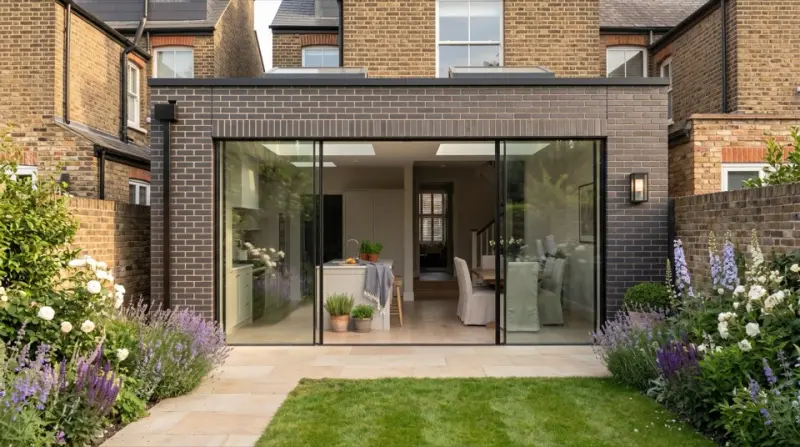
See it for your own home: put in your address and get free concept drawings and an indicative price. Get my free concept → Or see our Kitchen Fitting →
A kitchen extension is one of the most impactful home improvements you can make in 2026. Whether you want an open-plan kitchen-diner, a utility room, or bi-fold doors opening onto the garden, extending your kitchen typically adds the most value per pound spent. But before you pick tiles or light fittings, you need a realistic budget.
In 2026, a kitchen extension in the UK costs between £2,000 and £3,000 per square metre on average. For a typical 20 m² kitchen extension, that means a total project cost of roughly £40,000 to £60,000 — though prices can swing significantly depending on location, finish level, and structural complexity. In London and the South East, expect to pay 30–50% more than the UK baseline. In the North and Midlands, costs can be 10–20% lower.
These figures are consistent with current industry data from the HomeOwners Alliance. In this guide, we break down every cost component, show you where your money goes, and explain how to get an accurate, address-specific estimate in minutes.
Table of Contents
- Kitchen Extension Cost at a Glance
- Cost Breakdown by Project Size
- Location-Specific Pricing (2026)
- What Affects the Cost of a Kitchen Extension?
- How to Save Money on Your Kitchen Extension
- Do You Need Planning Permission?
- Hidden Costs to Budget For
- How to Get an Accurate Quote for Your Home
- FAQs
Kitchen Extension Cost at a Glance
The table below gives a quick overview of what UK homeowners are paying for kitchen extensions in 2026. These figures include construction, fittings, and a mid-range kitchen finish. They do not include the cost of the kitchen units, appliances, or professional fees unless stated.
| Cost Component | Low End | Average | High End |
|---|---|---|---|
| Construction (per m²) | £2,000 | £2,500 | £3,000 |
| 15 m² kitchen extension | £30,000 | £37,500 | £45,000 |
| 20 m² kitchen extension | £40,000 | £50,000 | £60,000 |
| 25 m² kitchen extension | £50,000 | £62,500 | £75,000 |
| 30 m² kitchen extension | £60,000 | £75,000 | £90,000 |
| Kitchen units & appliances (mid-range) | £10,000 | £15,000 | £25,000 |
| Planning permission (householder) | — | £206 | — |
| Building regulations | £200 | £600 | £1,000 |
| Structural engineer | £500 | £1,250 | £2,000 |
| Architect (5–10% of build cost) | £3,750 | £5,625 | £7,500 |
| Party wall agreement | £700 | £1,350 | £2,000 |
| Contingency (10–15%) | £4,000 | £7,500 | £11,250 |
Sources: HomeOwners Alliance extension cost data; indicative Suddeco estimates
Cost Breakdown by Project Size
Kitchen extensions vary enormously in size. A small side-return extension in a Victorian terrace might add just 6–8 m², while a large rear extension on a detached home could add 30 m² or more. Below, we break down typical project costs by size band.
Small Kitchen Extension (10–15 m²)
A small extension is often a side-return infill or a modest rear addition. It is enough for a galley kitchen expansion or a small breakfast area.
- Construction cost: £20,000–£45,000
- Kitchen units & appliances: £8,000–£15,000
- Professional fees: £2,000–£5,000
- Total typical cost: £30,000–£65,000
Medium Kitchen Extension (16–24 m²)
This is the most common size band. It typically allows for an open-plan kitchen-diner with an island or a peninsula, plus space for a small sofa or play area.
- Construction cost: £32,000–£72,000
- Kitchen units & appliances: £12,000–£20,000
- Professional fees: £3,000–£7,000
- Total typical cost: £47,000–£99,000
Large Kitchen Extension (25–35 m²)
A large extension suits detached or semi-detached properties with generous gardens. It can accommodate a full kitchen, dining area, and a separate living zone with bi-fold doors.
- Construction cost: £50,000–£105,000
- Kitchen units & appliances: £18,000–£30,000
- Professional fees: £4,000–£10,000
- Total typical cost: £72,000–£145,000
Tip: The most cost-effective kitchen extensions are often in the 18–22 m² range. Beyond this, you enter diminishing returns per square metre because foundation and roof costs do not scale linearly with internal space.
Location-Specific Pricing (2026)
Where you live in the UK has a significant impact on your kitchen extension cost. Labour rates, material costs, and demand all vary by region.
London
London commands the highest premiums in the UK. A kitchen extension in zones 1–3 can cost 30–50% more than the national average. A 20 m² kitchen extension in London typically ranges from £55,000 to £85,000 for construction alone, with premium finishes pushing totals well above £100,000.
- Per m²: £2,600–£4,500
- Key factors: High labour costs, access constraints, parking restrictions, and premium material suppliers
South East (Surrey, Kent, Hampshire, Berkshire, Sussex)
The South East is the second-most expensive region. Expect a 20–30% premium over the national average.
- Per m²: £2,400–£3,900
- Key factors: High demand, affluent homeowners investing in premium finishes, and shortage of skilled trades
South West, East Anglia, and the Midlands
These regions broadly track the UK average, with some local variation. A 20 m² kitchen extension here typically costs £42,000 to £58,000 for construction.
- Per m²: £2,000–£3,000
- Key factors: Moderate labour rates, good availability of builders, reasonable access to materials
North of England, Wales, Scotland, and Northern Ireland
Northern regions offer the best value for kitchen extensions. Costs are typically 10–20% below the national average.
- Per m²: £1,600–£2,500
- Key factors: Lower labour costs, less competition for trades, but potentially longer lead times for specialist materials
What Affects the Cost of a Kitchen Extension?
Understanding the cost drivers helps you control your budget and make informed trade-offs. Here are the main factors that affect the total price of your kitchen extension in 2026.
1. Size and Footprint
The most obvious factor. Larger extensions cost more in absolute terms, but the cost per m² often drops slightly as you move beyond 20 m² because fixed costs (foundations, roof structure, external walls) are spread over a larger area. Conversely, very small extensions (under 10 m²) can have a surprisingly high per-m² cost because fixed overheads are not spread efficiently.
2. Structural Complexity
- Single-storey rear extension: Typically the cheapest option. Standard foundations, pitched or flat roof, straightforward structural work.
- Side-return extension: Often involves working around existing drains, chimneys, and party walls. Can be more complex per m² than a rear extension.
- Wrap-around extension: Combines rear and side return. More external wall, more roof, more complex junctions. Expect a 10–15% premium over a simple rear extension.
- Double-storey extension: Adds a bedroom or bathroom above the kitchen. Roughly 60–70% more than a single-storey equivalent because of the additional floor structure, staircase, and roof work — but you gain far more usable space.
3. Materials and Finish Level
- Basic finish: Standard white UPVC windows, laminate worktops, basic cabinetry, vinyl flooring. Keeps costs down but lacks resale impact.
- Mid-range finish: Engineered stone worktops, timber or aluminium windows, quality branded kitchen units, porcelain tiles. This is where most homeowners land in 2026.
- High-end finish: Bespoke cabinetry, Gaggenau or Miele appliances, underfloor heating, Crittall-style doors, statement lighting. Can easily double the kitchen component cost.
4. Ground Conditions and Foundations
Poor ground conditions (clay soil, high water table, trees nearby) can require deeper foundations or piling. This can add £3,000–£10,000 to the project. A site survey and soil investigation are worth every penny before you start.
5. Services and Utilities
Moving drains, gas mains, or electrical supplies adds cost. If your kitchen extension covers a manhole or requires a new boiler location, budget an extra £1,000–£5,000.
6. Glazing
Bi-fold doors, sliding doors, and roof lanterns are popular in kitchen extensions but add significant cost. A 3-metre set of aluminium bi-fold doors can cost £3,000–£6,000. A large roof lantern adds £2,000–£5,000. These are often worth the investment for light and garden connection.
7. Kitchen Units and Appliances
These are often overlooked in extension budgets. A mid-range kitchen from a reputable supplier costs £12,000–£20,000 including appliances. High-end bespoke kitchens can exceed £40,000. Budget for this separately from the construction cost.
How to Save Money on Your Kitchen Extension
A kitchen extension is a major investment, but there are smart ways to control costs without compromising quality.
1. Get Your Design Right Before You Build
Changes on site are expensive. A well-thought-out design with detailed plans reduces variations, disputes, and wasted materials. Our Concept Package delivers architect-quality plans in 48 hours, so you can price accurately before breaking ground.
2. Choose a Standard Roof Structure
A simple pitched roof or flat roof with EPDM membrane is cheaper than a complex vaulted ceiling with exposed steel beams and rooflights. If you want height and light, consider a standard roof with one well-placed roof lantern instead of full glazing.
3. Keep the Layout Simple
L-shaped or rectangular footprints are cheaper to build than T-shaped or irregular footprints. Every external corner adds wall, roof, and foundation cost. A simple rectangle maximises internal space per pound spent.
4. Source Your Kitchen Separately
Some builders mark up kitchen supply significantly. If you are confident managing deliveries, consider sourcing your kitchen directly from a supplier and having your builder install it. This can save 10–20% on the kitchen component.
5. Time Your Project Carefully
Spring and summer are peak building seasons. Prices and lead times are higher. If you can start in late autumn or winter, you may secure better rates and faster availability. Internal finishing work can then continue through the colder months.
6. Use Our Free Render Tool
Before you spend a penny on design or planning, get a free render of your kitchen extension. Enter your address and see what similar projects have been approved nearby, with instant 3D renders and a cost estimate tailored to your location.
Do You Need Planning Permission?
Many kitchen extensions fall under Permitted Development (PD) rights, meaning you do not need full planning permission if you meet certain criteria:
- The extension is no more than 4 metres beyond the rear wall of a detached house (3 metres for other properties).
- The total height does not exceed 4 metres.
- The materials are similar in appearance to the existing house.
- It is not in a designated area (conservation area, Area of Outstanding Natural Beauty, National Park) without additional restrictions.
However, all kitchen extensions require Building Regulations approval regardless of planning status. This covers structural safety, insulation, ventilation, fire safety, and electrical work. Building regulations approval typically costs £200–£1,000 depending on your local authority and whether you use a private inspector.
If your property is in a conservation area, is a listed building, or your plans exceed PD limits, you will need householder planning permission, which costs £206 in England (as of 2026). For more complex projects, full planning permission may be required at £462.
Unsure about your property? Our platform checks your address against local planning data and tells you exactly what permissions you need. Get your free render to find out.
Hidden Costs to Budget For
Beyond the obvious construction and kitchen costs, budget for these often-overlooked items:
| Hidden Cost | Typical Range |
|---|---|
| Site survey and soil investigation | £500–£1,500 |
| Tree survey (if near protected trees) | £300–£800 |
| Building regulations | £200–£1,000 |
| Structural engineer calculations | £500–£2,000 |
| Architect / architectural designer | £3,750–£7,500 (5–10% of build) |
| Party wall surveyor | £700–£2,000 |
| Planning permission | £206 (householder) / £462 (full) |
| Temporary kitchen | £500–£2,000 |
| Garden restoration | £2,000–£8,000 |
| Insurance and warranties | £500–£1,500 |
| Contingency | 10–15% of total build cost |
Total hidden costs: Typically £10,000–£20,000 on a £50,000 kitchen extension. Add 10–15% contingency on top of everything.
How to Get an Accurate Quote for Your Home
Online guides are a useful starting point, but the only way to get an accurate cost for your kitchen extension is to analyse your specific property, location, and local planning context. Here is how to do it in 2026.
Step 1: Check What Your Neighbours Built
The best indicator of what is possible and what it costs is what has already been approved on your street. Our platform reads planning data for your address and shows you nearby approved kitchen extensions, with estimated costs.
Step 2: Get an Instant Render and Estimate
Our free render tool generates a 3D visualisation of your kitchen extension based on your address and neighbouring precedents. It also produces a location-specific cost estimate and a basic plan.
Step 3: Upgrade to a Concept Package
For a detailed design, choose our Concept Package at £495 (or £995 for complex projects). You receive three renders, full architectural plans, one revision, and delivery within 48 hours. This gives you everything you need to get accurate builder quotes.
Step 4: Design + Planning Package
If you need planning permission, building regulations, and a structural engineer, our Design+Planning Package at £2,495 includes the full planning application, unlimited revisions, and support through approval.
Step 5: Design-to-Build
In London, our Design-to-Build service is delivered by Suddeco’s own team — design, planning and the build itself, with project management, staged milestone payments and a 12-month warranty. Fees are a fixed fee plus a percentage of the build cost.
FAQs
How much does a 20 m² kitchen extension cost in 2026?
A 20 m² kitchen extension in the UK costs between £40,000 and £60,000 for construction, plus £12,000–£20,000 for kitchen units and appliances. Total project costs typically range from £52,000 to £80,000 before professional fees and contingency. In London, expect to pay £55,000–£85,000 for construction alone.
What is the cheapest way to extend a kitchen?
The cheapest way to extend a kitchen is to build a single-storey rear extension under Permitted Development rights, using a simple rectangular footprint, standard materials, and a mid-range kitchen. Avoid complex structural changes, extensive glazing, and premium finishes. Budget around £30,000–£40,000 for a modest 12–15 m² extension in the North or Midlands.
Does a kitchen extension add value to your home?
Yes. A well-designed kitchen extension typically adds 5–15% to the value of your home, according to the HomeOwners Alliance. In high-value areas like London and the South East, the return can be even higher. A £60,000 kitchen extension can add £80,000–£120,000 to your property value, making it one of the best investments you can make.
How long does a kitchen extension take to build?
A typical single-storey kitchen extension takes 8–14 weeks to build, depending on size, complexity, and weather. The planning and design phase adds 4–12 weeks before construction starts. With our platform, you can compress the design phase to 48 hours for a Concept Package.
Can I build a kitchen extension without planning permission?
Many kitchen extensions can be built under Permitted Development rights, provided they meet size and height limits. However, all extensions require Building Regulations approval. Our platform checks your address and tells you exactly which permissions apply.
Is it cheaper to extend the kitchen or convert the loft?
A loft conversion is typically cheaper per square metre (£1,500–£2,500/m²) than a kitchen extension (£2,000–£3,000/m²) because the structure already exists. However, a kitchen extension usually adds more value to your home and is more frequently used. The best choice depends on your property, budget, and goals.
What is the most expensive part of a kitchen extension?
The structure itself (foundations, walls, roof, and windows) is usually the most expensive component, accounting for 50–60% of the total cost. The kitchen units and appliances are the second-largest expense at 20–30%. Professional fees, planning, and building regulations make up the remainder.
How much does a side-return kitchen extension cost?
A side-return kitchen extension typically costs £25,000–£50,000 for construction, depending on width, length, and structural complexity. Because side returns are narrow and often involve complex junctions with existing walls and drains, the per-m² cost can be higher than a simple rear extension.
Do I need an architect for a kitchen extension?
You do not legally need an architect, but professional design is highly recommended. A good architectural designer ensures your extension is structurally sound, compliant with regulations, and maximises value. Our Concept Package delivers architect-quality plans at a fraction of traditional architect fees.
Can I live in my house during a kitchen extension?
Yes, but it is challenging. Most homeowners set up a temporary kitchen in a utility room, garage, or dining room. Dust, noise, and disruption are significant. Budget for a temporary kitchen setup (£500–£2,000) and consider moving out for 2–4 weeks during the most disruptive phase if your budget allows.
What is the difference between a kitchen extension and an orangery?
An orangery has more glazing than a traditional extension, typically with a lantern roof and large windows. It feels more like a garden room. An orangery costs £2,000–£3,000/m² — similar to a kitchen extension — but the glazing component is higher. A kitchen extension is more practical for year-round cooking and dining.
What is included in Suddeco's free render?
Our free render includes an address-based instant 3D visualisation of your potential kitchen extension, a basic plan, and a location-specific cost estimate based on nearby approved planning applications. No credit card required. Upgrade to a Concept Package for detailed plans and multiple renders.
Related Articles
- Kitchen Extension Cost per m²: The Complete 2026 Guide
- How Much Does a Loft Conversion Cost in 2026?
- Do I Need Planning Permission for an Extension?
- Suddeco Pricing and Packages
Last updated: 15 January 2026. Cost figures are based on industry data from the HomeOwners Alliance, adjusted for inflation and 2026 market conditions. Prices vary by location, specification, and contractor. Always obtain detailed quotes before committing to a project.
See it before you spend a penny
Get a free render of your finished project + a real price — in minutes.
Get your free concept →