Kitchen Extension Cost per m²: The Complete 2026 Guide
Last updated: 21 September 2026
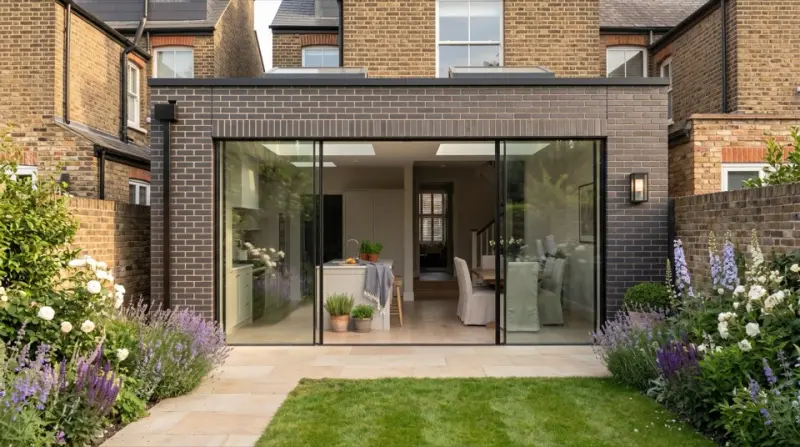
See it for your own home: put in your address and get free concept drawings and an indicative price. Get my free concept → Or see our Kitchen Fitting →
If you are planning a kitchen extension in 2026, the cost per square metre is the single most important number to understand. It is the benchmark builders use, the metric architects quote, and the figure that determines whether your project stays within budget or spirals out of control.
In 2026, kitchen extensions in the UK cost between £2,000 and £3,000 per square metre for a mid-range, single-storey build. That figure includes construction, basic electrics and plumbing, standard windows, and a mid-level finish. It does not include kitchen units, appliances, professional fees, or contingency.
This guide breaks down exactly what you get for that per-m² price, how it changes by location, extension type, and specification, and how to calculate an accurate total for your specific project. All figures are consistent with 2026 industry data from the HomeOwners Alliance.
Table of Contents
- What Is the Average Cost per m² for a Kitchen Extension in 2026?
- Cost per m² by Extension Type
- Cost per m² by Location
- Cost per m² by Finish Level
- Cost per m² by Project Size
- What Is Included in the per m² Price?
- What Is NOT Included in the per m² Price?
- How to Calculate Your Total Kitchen Extension Cost
- How to Reduce Your Cost per m²
- FAQs
What Is the Average Cost per m² for a Kitchen Extension in 2026?
The table below shows the cost per m² for kitchen extensions across the UK in 2026, broken down by the three most common price bands.
| Price Band | Cost per m² | Typical Specification |
|---|---|---|
| Budget | £1,800–£2,200 | Standard materials, basic kitchen, minimal glazing, simple roof, no structural complexity |
| Mid-range | £2,200–£2,700 | Quality materials, good kitchen, some glazing (bi-folds or roof lantern), standard pitched or flat roof |
| Premium | £2,700–£3,500+ | High-end materials, bespoke kitchen, extensive glazing, complex roof, underfloor heating, smart home integration |
National average (2026): £2,500 per m²
These are construction-only costs. For every £1,000 you spend on construction, you should budget an additional £400–£600 for kitchen units, appliances, professional fees, and contingency. This means a true all-in cost per m² of roughly £3,000–£4,500 for a mid-range project.
Cost per m² by Extension Type
Not all kitchen extensions are built the same way. The type of extension you choose has a direct impact on the cost per m².
Single-Storey Rear Extension
The most common and typically the most cost-effective type of kitchen extension.
- Cost per m²: £1,800–£2,800
- Why: Simple rectangular footprint, straightforward foundations, standard roof structure. No complex junctions with existing walls.
- Best for: Most detached, semi-detached, and end-of-terrace properties with garden space.
Side-Return Extension
Popular in Victorian and Edwardian terraced houses, where the narrow alleyway beside the kitchen is infilled.
- Cost per m²: £2,000–£3,000
- Why: Narrow working space, party wall complications, existing drains and services often need rerouting. The per-m² cost is higher because the floor area gained is small relative to the structural work required.
- Best for: Victorian terraces in London, Bristol, Brighton, and Manchester.
Wrap-Around Extension
Combines a rear extension with a side return, creating an L-shaped footprint.
- Cost per m²: £2,000–£3,000
- Why: More external wall, more roof area, complex junctions at the corner. The per-m² cost is similar to a side return, but you gain significantly more space.
- Best for: Properties where a rear extension alone would not provide enough width.
Double-Storey Extension
Extends both the kitchen and a room above (typically a bedroom or bathroom).
- Cost per m²: £1,800–£2,500
- Why: The per-m² cost is lower than a single-storey extension because the foundations and roof are spread over two floors. However, the total project cost is 60–70% higher because you are building twice the floor area. A staircase and additional structural work also add cost.
- Best for: Growing families who need both kitchen space and an extra bedroom.
Conservatory / Orangery Kitchen Extension
A kitchen extension with a high proportion of glazing, often with a glass or lantern roof.
- Cost per m²: £2,000–£3,000 (orangery) / £1,200–£2,000 (conservatory)
- Why: High glazing costs are offset by simpler wall construction. Orangeries feel more premium and are better insulated than traditional conservatories. A conservatory is cheaper but less suitable for year-round kitchen use without substantial heating upgrades.
- Best for: Properties where garden views and natural light are a priority.
Cost per m² by Location
Labour and material costs vary significantly across the UK. The table below shows the cost per m² for a mid-range kitchen extension by region in 2026.
| Region | Cost per m² (mid-range) | Premium vs. National Average |
|---|---|---|
| London (Zones 1–3) | £2,600–£4,500 | +30–50% |
| London (Outer) | £2,400–£3,500 | +20–30% |
| South East | £2,400–£3,900 | +20–30% |
| South West | £2,000–£3,000 | National average |
| East Anglia | £2,000–£3,000 | National average |
| East Midlands | £1,900–£2,800 | -5–10% |
| West Midlands | £1,900–£2,800 | -5–10% |
| North West | £1,800–£2,600 | -10–15% |
| North East | £1,700–£2,500 | -10–20% |
| Yorkshire & Humber | £1,800–£2,600 | -10–15% |
| Wales | £1,800–£2,700 | -10–15% |
| Scotland | £1,700–£2,600 | -10–20% |
| Northern Ireland | £1,700–£2,500 | -10–20% |
London premium explained: London builders charge more due to higher wages, congestion and parking restrictions, limited access for materials, and higher insurance and compliance costs. A 20 m² kitchen extension in Kensington or Clapham can cost £55,000–£85,000 for construction alone, compared to £40,000–£55,000 in Leeds or Manchester.
Cost per m² by Finish Level
The level of finish you choose has a major impact on the cost per m². Below is a detailed breakdown of what each level includes and how it affects pricing.
Budget Finish (£1,800–£2,200/m²)
- Windows: White UPVC double glazing
- Doors: Standard French doors or basic patio doors
- Roof: Flat roof with EPDM or standard pitched roof with concrete tiles
- Flooring: Ceramic or porcelain tiles, vinyl in utility areas
- Kitchen: Off-the-shelf units (Howdens, Wickes, IKEA), laminate worktops, standard appliances
- Lighting: Basic LED downlights, standard pendant
- Heating: Standard radiator extension from existing boiler
- Suitable for: Rental properties, first-time renovators, or tight budgets where functionality matters more than aesthetics.
Mid-Range Finish (£2,200–£2,700/m²)
- Windows: Aluminium or timber-effect UPVC
- Doors: Aluminium bi-fold or sliding doors (2.5–3.5 m width)
- Roof: Pitched roof with slate or clay tiles, or flat roof with single-ply membrane and one roof lantern
- Flooring: Large-format porcelain tiles, engineered wood
- Kitchen: Branded supplier (Magnet, Wren, John Lewis), engineered stone or quartz worktops, Bosch/Samsung appliances
- Lighting: Recessed LED spots, under-cabinet lighting, pendant over island
- Heating: Underfloor heating in kitchen area, upgraded radiator elsewhere
- Suitable for: Most family homes. This is the sweet spot for value and resale appeal.
Premium Finish (£2,700–£3,500+/m²)
- Windows: Aluminium or steel-frame (Crittall-style), triple glazing
- Doors: Large-format aluminium sliding doors (4+ metres), or bespoke timber bi-folds
- Roof: Complex pitched roof with Velux or bespoke rooflights, or a living roof (sedum)
- Flooring: Natural stone, premium engineered oak, or polished concrete
- Kitchen: Bespoke cabinetry (deVOL, Harvey Jones, Plain English), natural stone or composite worktops, Gaggenau/Miele appliances, boiling water tap, integrated bin and recycling
- Lighting: Bespoke pendant lighting, smart lighting system, feature wall lighting
- Heating: Wet underfloor heating throughout, separate zone controls, air source heat pump or integrated MVHR
- Suitable for: High-value properties, design-led renovations, or homeowners who plan to stay long-term.
Cost per m² by Project Size
The size of your extension affects the cost per m² in a non-obvious way. Very small and very large extensions both have cost inefficiencies.
| Extension Size | Cost per m² | Why? |
|---|---|---|
| 6–10 m² | £2,500–£3,500 | High fixed costs (foundations, roof, access) spread over a small area. Complex side returns often fall in this band. |
| 11–20 m² | £2,000–£2,800 | The sweet spot. Fixed costs are spread efficiently, and standard construction methods apply. |
| 21–30 m² | £1,800–£2,600 | Economies of scale begin to apply. Larger foundations and roofs are more efficient per m². |
| 30+ m² | £1,800–£2,500+ | Potentially lower per m², but premium finishes and complex glazing often push costs back up. |
Key insight: A 15 m² extension does not cost exactly 50% more than a 10 m² extension. The 15 m² project will have a lower cost per m² because the fixed costs (digging foundations, scaffolding, site setup) are shared across more floor area.
What Is Included in the per m² Price?
When a builder quotes £2,500 per m², what exactly are you paying for? Here is a typical breakdown of what is included in a standard construction cost per m² for a kitchen extension in 2026.
Included in the Construction Cost per m²:
- Foundations: Strip or trench fill foundations to a standard depth (typically 1 metre, or deeper if specified by engineer)
- External walls: Cavity walls with insulation, blockwork and brick facing (or rendered block), lintels over openings
- Roof structure: Timber or steel joists, roof covering (tiles, slate, or flat roof membrane), fascias, soffits, and gutters
- Windows and external doors: Standard double glazing, trickle vents, ironmongery
- Internal walls: Stud partitions if required, plasterboard, plaster finish
- Electrical work: First and second fix, including sockets, lighting, cooker circuit, and consumer board upgrade if needed
- Plumbing: First and second fix, including hot and cold feeds, waste pipes, and radiator connections
- Floor construction: Concrete slab or suspended floor, insulation, screed or timber floor structure
- Ceiling: Plasterboard ceiling, plaster finish, basic downlights
- Decoration: White emulsion walls and ceilings, undercoat and gloss on woodwork (if included — check with your builder)
Sometimes Included (check your quote):
- Kitchen installation: Some builders include fitting a kitchen you supply. Others charge extra.
- Tiling: Floor and wall tiling may be included in a mid-range quote, or may be an extra.
- External works: Patio, steps, and drainage connections are often excluded.
What Is NOT Included in the per m² Price?
This is where many homeowners get caught out. The per m² construction cost is only part of the story. Budget separately for the following items, which typically add £500–£1,500 per m² to the all-in cost.
Excluded from the Construction Cost per m²:
| Item | Cost Range | Notes |
|---|---|---|
| Kitchen units and appliances | £8,000–£30,000+ | Depending on brand and size. Budget £400–£1,000 per m² of kitchen space. |
| Tiling (floor and walls) | £1,500–£5,000 | Premium tiles and mosaic work cost more. |
| Worktops | £1,500–£5,000 | Laminate is cheap; quartz, granite, and Dekton are premium. |
| Glazing upgrades | £2,000–£8,000 | Bi-fold doors, sliding doors, roof lanterns, and large windows are extras. |
| Underfloor heating | £1,500–£4,000 | Electric mats are cheaper; wet systems are more expensive but efficient. |
| Structural engineer | £500–£2,000 | Required for all but the simplest extensions. |
| Architect / designer | £3,750–£7,500 | 5–10% of construction cost. |
| Planning permission | £206 / £462 | Householder / full application fees. |
| Building regulations | £200–£1,000 | Local authority or private inspector fees. |
| Party wall surveyor | £700–£2,000 | Required if you share a wall with a neighbour. |
| Site clearance and preparation | £500–£3,000 | Removing old structures, trees, or difficult access. |
| External works (patio, drainage) | £2,000–£8,000 | Connecting drains, laying patios, landscaping. |
| Contingency | 10–15% | Essential buffer for unexpected issues. |
All-in cost per m² (including everything): For a mid-range kitchen extension, budget £3,000–£4,500 per m² when you include kitchen, fees, and contingency.
How to Calculate Your Total Kitchen Extension Cost
Follow this step-by-step method to calculate an accurate total cost for your kitchen extension.
Step 1: Measure Your Proposed Footprint
Measure the external dimensions of your proposed extension. Multiply length by width to get the area in square metres. For an L-shaped wrap-around, calculate each section separately and add them together.
Step 2: Choose Your Location Multiplier
Use the location table above to find your regional cost per m². If you are in London, use the upper end of the range. If you are in the North East or Scotland, use the lower end.
Step 3: Choose Your Finish Level
Decide whether you want budget, mid-range, or premium finishes. Be honest about what you can afford and what will add value to your home.
Step 4: Apply the Formula
Construction cost = Area (m²) × Cost per m² (location + finish)
All-in cost = Construction cost + Kitchen (£8k–£30k) + Fees (£5k–£10k) + Contingency (10–15%)
Example Calculation: 20 m² Mid-Range Kitchen Extension in Manchester
- Area: 20 m²
- Location multiplier: North West (£1,800–£2,600/m²) → use £2,200/m² for mid-range
- Construction cost: 20 × £2,200 = £44,000
- Kitchen units and appliances: £15,000
- Professional fees: £6,000
- Subtotal: £65,000
- Contingency (12%): £7,800
- Total all-in cost: £72,800
- All-in cost per m²: £72,800 ÷ 20 = £3,640/m²
Example Calculation: 20 m² Mid-Range Kitchen Extension in London
- Area: 20 m²
- Location multiplier: London (£2,600–£4,500/m²) → use £3,000/m² for mid-range
- Construction cost: 20 × £3,000 = £60,000
- Kitchen units and appliances: £18,000 (London premium on kitchen supply)
- Professional fees: £8,000
- Subtotal: £86,000
- Contingency (12%): £10,320
- Total all-in cost: £96,320
- All-in cost per m²: £96,320 ÷ 20 = £4,816/m²
How to Reduce Your Cost per m²
A lower cost per m² does not have to mean lower quality. Here are proven ways to reduce your cost per m² without cutting corners.
1. Optimise Your Footprint
A simple rectangular shape is the most cost-effective. Every external corner, jog, or bay window adds wall, roof, and foundation cost. Design a shape that maximises internal floor area relative to external perimeter.
2. Build in the Right Season
Builders are quieter in autumn and winter. You may secure a 5–10% discount on labour, and trades are more readily available. The downside is potential weather delays, but a good builder plans for this.
3. Use Standard Materials
Bespoke handmade bricks, imported tiles, and custom steelwork look beautiful but add cost. Standard materials from UK suppliers are cheaper, faster to source, and easier to replace if damaged.
4. Minimise Structural Changes
Avoid knocking down internal load-bearing walls unless essential. If you do need to remove a wall, a steel beam is cheaper than a full structural frame. Keep the existing kitchen layout where possible to reduce plumbing and electrical relocation costs.
5. Source Your Kitchen Independently
Builder-supplied kitchens often carry a markup. If you are confident managing delivery and installation scheduling, source your kitchen directly from a supplier and have your builder fit it. This can save 10–20%.
6. Get Your Design Right First Time
Changes on site are the biggest driver of cost overruns. A detailed, approved set of plans before construction starts eliminates variations and disputes. Our Concept Package delivers detailed plans in 48 hours for £495–£995, potentially saving you thousands in avoidable changes.
7. Start with a Free Render
Before you spend money on design, get an address-specific cost estimate. Our free render tool analyses nearby approved planning applications and generates an instant cost estimate and 3D visualisation for your property. No credit card required.
FAQs
What is the average cost per m² for a kitchen extension in 2026?
The average cost per m² for a kitchen extension in the UK in 2026 is £2,000–£3,000 for construction only. The all-in cost, including kitchen units, appliances, professional fees, and contingency, is typically £3,000–£4,500 per m².
Why does the cost per m² vary so much?
Cost per m² varies due to location (London is 30–50% more expensive), extension type (side returns are more complex), finish level (premium materials cost more), ground conditions (poor soil requires deeper foundations), and the proportion of glazing (bi-fold doors and roof lanterns add cost).
Is a kitchen extension cheaper than a house extension?
Kitchen extensions are typically more expensive per m² than a general house extension because they require more plumbing, electrics, ventilation, and a higher standard of finish. A general rear extension costs £1,800–£2,800/m², while a kitchen extension costs £2,000–£3,000/m². However, kitchen extensions also add more value to your home.
What is the cheapest cost per m² for a kitchen extension?
The cheapest kitchen extensions cost around £1,600–£1,800 per m² in the North of England or Scotland, using basic materials and a simple rectangular footprint. All-in costs at this level are approximately £2,500–£3,000 per m² including kitchen, fees, and contingency.
Does cost per m² go down for larger extensions?
Yes, up to a point. Extensions between 15 m² and 25 m² have the most efficient cost per m² because fixed costs (foundations, roof, site setup) are spread over a larger area. Very small extensions (under 10 m²) have a high cost per m² because fixed costs dominate. Very large extensions (30+ m²) may see per-m² costs rise again if premium finishes and glazing are used.
How much does a kitchen extension cost per m² in London?
In London, a kitchen extension costs £2,600–£4,500 per m² for construction, depending on zone, finish level, and access constraints. The all-in cost, including kitchen and fees, is typically £4,000–£6,500 per m².
What is the most expensive element per m² in a kitchen extension?
Glazing is typically the most expensive element per m². A square metre of aluminium bi-fold door or roof lantern can cost £1,500–£3,000, compared to £200–£400 for a standard brick wall. High-spec kitchens are also expensive per m², with bespoke cabinetry costing £500–£1,000 per linear metre.
Should I budget for cost per m² or total project cost?
Both. The cost per m² is useful for comparing quotes, benchmarking your project, and evaluating different design options. The total project cost is what you actually need to finance. Always calculate the total cost by multiplying your area by the per-m² rate, then adding kitchen, fees, and contingency.
How does a side-return extension cost per m² compare to a rear extension?
A side-return extension typically costs £2,000–£3,000 per m², which is at the upper end of or slightly above a simple rear extension. This is because side returns involve narrow access, complex junctions with existing walls, and often require rerouting drains and services.
What does a £2,500 per m² kitchen extension look like?
At £2,500 per m² (mid-range), you can expect: a single-storey rear extension with a pitched roof; aluminium or quality UPVC windows; a 3-metre set of aluminium bi-fold doors; engineered stone or quartz worktops; a branded kitchen with Bosch-level appliances; porcelain floor tiles; and underfloor heating in the kitchen area. This is the specification most UK homeowners choose in 2026.
What is the all-in cost per m² for a high-end kitchen extension?
A high-end kitchen extension in 2026 has an all-in cost per m² of £4,500–£6,000+. This includes premium construction, bespoke cabinetry, high-end appliances (Gaggenau, Miele), extensive glazing, underfloor heating, smart home integration, and all professional fees and contingency.
Can I get an accurate cost per m² estimate for my specific address?
Yes. Our free render tool analyses your address and nearby approved planning applications to generate an instant, location-specific cost estimate and 3D visualisation. For a detailed design, upgrade to our Concept Package (£495–£995) for full plans and multiple renders.
Related Articles
- How Much Does a Kitchen Extension Cost in 2026? [UK Guide]
- How Much Does a Loft Conversion Cost in 2026?
- Side Return Extension Cost: 2026 Pricing Guide
- Suddeco Pricing and Packages
Last updated: 15 January 2026. Cost figures are based on industry data from the HomeOwners Alliance, adjusted for inflation and 2026 market conditions. Cost per m² is an average and actual prices vary by location, specification, and contractor. Always obtain detailed quotes before committing to a project.
See it before you spend a penny
Get a free render of your finished project + a real price — in minutes.
Get your free concept →