Party Wall Agreement Cost: What You Need to Know in 2026 (UK Guide)
Last updated: 21 September 2026
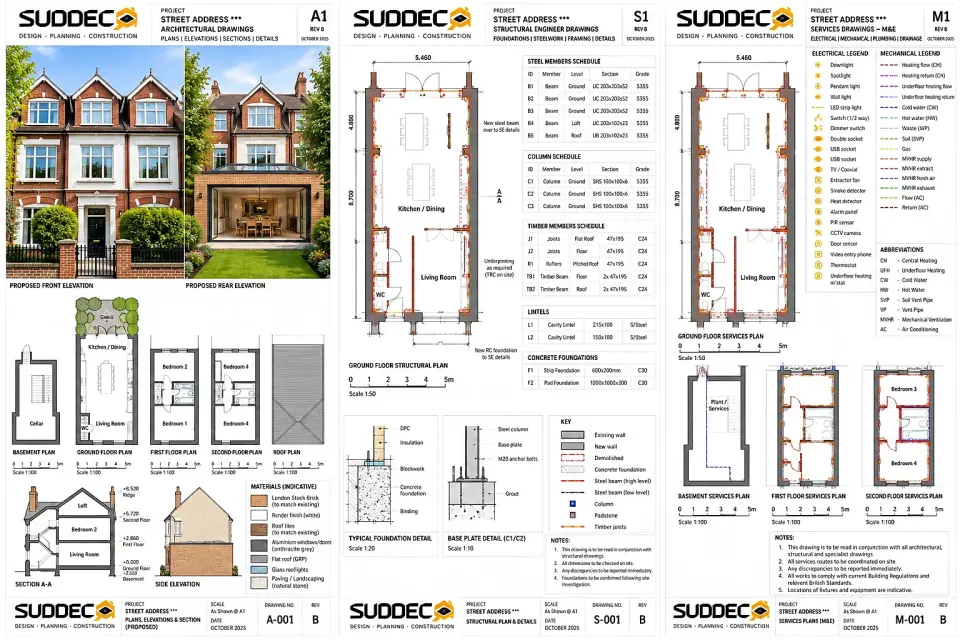
See it for your own home: put in your address and get free concept drawings and an indicative price. Get my free concept → Or see our Party Wall →
If you are planning an extension that involves work on or near a shared wall, boundary, or your neighbour's property, the Party Wall etc. Act 1996 applies. For many UK homeowners, this is one of the most overlooked — and potentially costly — steps in the renovation process.
So what does a party wall agreement actually cost? In 2026, party wall surveyor fees typically range from £700 to £2,000 for a standard residential extension. If both you and your neighbour appoint separate surveyors, and those surveyors then appoint a third "agreed surveyor," your total bill can reach £2,500–£4,000. For complex disputes or multiple adjoining properties, costs can climb even higher.
This guide explains every cost element, when you need a party wall agreement, how to keep costs down, and what happens if things go wrong. At Suddeco, we help you understand these obligations before you start — our free render tool shows what your extension will look like and flags whether party wall issues are likely, so you can budget accurately from day one.
Table of Contents
- What Is a Party Wall Agreement?
- When Do You Need a Party Wall Agreement?
- Party Wall Agreement Cost Breakdown (2026)
- Location-Specific Pricing: London vs Rest of UK
- What Affects Party Wall Costs?
- How to Save Money on Party Wall Agreements
- The Party Wall Process: Step by Step
- What Happens If Your Neighbour Objects?
- The Suddeco Approach: Spot Party Wall Issues Early
- Frequently Asked Questions
- Get Your Free Render and Cost Estimate Today
What Is a Party Wall Agreement?
A party wall agreement is a legal document created under the Party Wall etc. Act 1996 that sets out the rights and obligations of neighbours when one party intends to carry out building work that affects a shared wall, boundary, or excavations near a neighbouring property.
The agreement is designed to: - Prevent and resolve disputes between neighbours - Ensure work is carried out safely and with proper oversight - Protect both parties' property rights - Provide a framework for compensation if damage occurs
The agreement is prepared by a party wall surveyor — a qualified professional who understands construction and the legal requirements of the Act. The surveyor(s) produce a document called an Award, which authorises the work, sets out how it will be done, and records the condition of the adjoining property before work begins.
When Do You Need a Party Wall Agreement?
You need a party wall agreement if your extension involves any of the following:
- Work on an existing party wall — e.g., cutting into it, raising it, demolishing and rebuilding it, or inserting a damp-proof course
- Building a new wall on the boundary line — between two properties
- Excavations within 3 metres of a neighbouring building — if the excavation goes deeper than the neighbour's foundations
- Excavations within 6 metres of a neighbouring building — if the excavation cuts a line drawn downwards at 45° from the bottom of the neighbour's foundations
Common Extension Scenarios That Trigger the Act
| Extension Type | Party Wall Likely? | Why |
|---|---|---|
| Single-storey rear extension | Sometimes | If within 3 m of neighbour's foundations and deeper than them |
| Double-storey rear extension | Often | Higher risk; deeper foundations; more impact on adjoining structure |
| Side return extension | Very likely | Built on or near the boundary; shared wall work common |
| Wrap-around extension | Very likely | Combines rear and side work; multiple boundaries affected |
| Loft conversion with party wall alterations | Very likely | Steel beams inserted into party wall; structural changes |
| Basement excavation | Almost certain | Deep excavations almost always trigger the 3 m or 6 m rule |
| Garage conversion | Rare | Usually internal; no shared wall work |
| Conservatory/orangery | Sometimes | If built on boundary or involves deep foundations |
If you are unsure whether the Act applies, the safest approach is to assume it does and seek professional advice. Ignoring the Party Wall Act can lead to injunctions, legal action, and costly delays — far more expensive than dealing with it properly upfront.
Party Wall Agreement Cost Breakdown (2026)
The cost of a party wall agreement depends on how many surveyors are involved, the complexity of the work, and whether your neighbour consents or dissents.
Scenario 1: Neighbour Consents (No Surveyor Needed)
If your neighbour agrees to the work in writing after receiving your notice, and no surveyor is appointed, the cost is minimal:
| Cost Item | Minimum | Average | Maximum |
|---|---|---|---|
| Party wall notice preparation | £0 | £50 | £150 |
| Postage/hand delivery | £5 | £10 | £20 |
| Total | £5 | £60 | £170 |
This is the best-case scenario, but it is less common than you might think. Many neighbours prefer the protection of a formal Award.
Scenario 2: One Agreed Surveyor
If your neighbour agrees to use the same surveyor as you (an "agreed surveyor"), costs are shared or paid by the building owner:
| Cost Item | Minimum | Average | Maximum |
|---|---|---|---|
| Agreed surveyor fee | £700 | £1,200 | £2,000 |
| Schedule of condition (neighbour's property) | £200 | £400 | £600 |
| Award preparation and administration | £100 | £200 | £400 |
| Total | £1,000 | £1,800 | £3,000 |
Scenario 3: Two Surveyors + Third Agreed Surveyor
If your neighbour appoints their own surveyor, and the two surveyors cannot agree, they appoint a third surveyor. Under the Act, the building owner (you) pays all reasonable surveyor fees:
| Cost Item | Minimum | Average | Maximum |
|---|---|---|---|
| Your surveyor fee | £700 | £1,200 | £2,000 |
| Neighbour's surveyor fee | £700 | £1,200 | £2,000 |
| Third surveyor fee (if required) | £500 | £800 | £1,500 |
| Schedule of condition (both sides) | £400 | £800 | £1,200 |
| Award preparation | £200 | £400 | £800 |
| Total | £2,500 | £4,400 | £7,500 |
Summary Cost Table
| Scenario | Total Cost Range | Likelihood |
|---|---|---|
| Neighbour consents without surveyor | £0–£170 | 15–20% |
| One agreed surveyor | £1,000–£3,000 | 50–60% |
| Two surveyors | £2,000–£4,000 | 20–25% |
| Two surveyors + third surveyor | £2,500–£7,500 | 5–10% |
External Cost Sources
These figures align with 2026 guidance from: - HomeOwners Alliance — homeowner-facing party wall cost guidance
Related reading: Understand how building regulations costs and planning permission fees add to your total project budget.
Location-Specific Pricing: London vs Rest of UK
Party wall surveyor fees vary significantly by region. London rates are among the highest in the UK due to demand, property values, and the complexity of urban terraced housing.
| Region | Agreed Surveyor Fee | Two Surveyor Scenario | Notes |
|---|---|---|---|
| London (Central/West) | £1,500–£2,500 | £3,500–£6,000 | Highest demand; complex stock; premium rates |
| London (Outer/East) | £1,200–£2,000 | £2,800–£5,000 | Moderate premium; high volume of extensions |
| South East | £1,000–£1,800 | £2,500–£4,500 | Strong market; good surveyor availability |
| South West | £900–£1,600 | £2,200–£4,000 | Lower demand than London; competitive pricing |
| Midlands | £800–£1,400 | £2,000–£3,500 | Balanced market; reasonable availability |
| North West / Yorkshire | £700–£1,200 | £1,800–£3,200 | Competitive rates; good surveyor coverage |
| North East / Scotland | £600–£1,100 | £1,600–£2,800 | Lowest rates; smaller market |
| Wales | £700–£1,200 | £1,800–£3,000 | Similar to North West; separate legal system but same Act |
Why London Costs More
- Higher property values mean surveyors charge more to reflect the risk and value of the assets involved
- Terraced and semi-detached density means more party wall situations per street
- Complex Victorian and Edwardian stock requires specialist knowledge of older construction methods
- Demand outstrips supply — good party wall surveyors are booked weeks in advance during peak spring and summer periods
For a standard London side return or wrap-around extension, budget £1,500–£2,500 for an agreed surveyor, and be prepared for £3,000–£5,000 if your neighbour appoints their own surveyor.
What Affects Party Wall Costs?
Several factors can push your party wall bill up or down. Understanding them helps you plan and, where possible, control costs.
1. Number of Adjoining Owners
If you share a boundary with multiple properties — for example, a corner plot or a mid-terrace house — you may need separate notices and agreements with each neighbour. Each additional neighbour adds £500–£2,000 to your total costs.
2. Complexity of the Work
| Work Type | Surveyor Time | Cost Impact |
|---|---|---|
| Simple rear extension; no structural party wall work | 4–8 hours | Lower end of range |
| Steel beams inserted into party wall | 10–15 hours | Mid-range |
| Basement excavation; underpinning | 20–40 hours | Upper end of range |
| Multiple walls affected; conservation area | 30–50+ hours | Highest costs |
3. Neighbour's Response
A neighbour who consents promptly and agrees to a single surveyor keeps costs low. A neighbour who: - Dissents and appoints their own surveyor - Requests multiple schedules of condition - Disputes the scope of work - Raises concerns about vibration, cracking, or structural safety
...can add hundreds or thousands of pounds in additional surveyor time.
4. Condition of the Adjoining Property
If your neighbour's property is already in poor condition, the surveyor must spend more time documenting the "before" state to avoid false damage claims. Older properties, listed buildings, or homes with existing subsidence require more detailed schedules of condition.
5. Timing and Urgency
Party wall surveyors, like all construction professionals, have busy periods. If you need an Award prepared urgently — for example, to match a builder's start date — you may pay a premium for fast-track service. Starting the process 2–3 months before construction begins avoids rush fees.
How to Save Money on Party Wall Agreements
Party wall costs are negotiable to a degree, and there are several strategies to keep your bill under control.
1. Talk to Your Neighbours Early
The single best way to save money is to have a friendly conversation with your neighbours before serving formal notices. Explain your plans, show them your drawings, and reassure them about dust, noise, and access. A neighbour who feels informed and respected is far more likely to consent or agree to a single surveyor.
2. Use Suddeco's Free Render to Show Your Plans Visually
A picture is worth a thousand words. Our free render tool generates a photorealistic image of your proposed extension from your address. Showing your neighbour exactly what you plan to build — and that it is well-designed — builds trust and reduces anxiety. Neighbours who understand the project are less likely to dissent.
3. Propose an Agreed Surveyor from the Start
When you serve your notice, suggest a specific agreed surveyor and explain that this will save both parties money. Name a qualified, chartered surveyor with good local reviews. If your neighbour trusts your choice, they are less likely to appoint their own.
4. Get Your Drawings Right Before Noticing
Incomplete or unclear drawings force surveyors to spend extra time clarifying the scope of work. Every hour of surveyor time costs £100–£250. Use Suddeco's Concept Package (£495–£995) to produce accurate, architect-quality drawings before you serve notices. Clear drawings reduce surveyor time and avoid disputes about what is actually being built.
5. Serve Notices at the Right Time
You must serve party wall notices at least 2 months before work begins (for party wall work) or 1 month before (for excavations). Missing these deadlines forces you to delay your builder or pay for expedited surveyor work. Build the notice period into your project timeline from the start.
6. Budget for the Worst Case
Even with the best preparation, you cannot control your neighbour's response. Budget for the two-surveyor scenario (£2,000–£4,000) and treat a lower bill as a saving. This prevents nasty surprises and project delays if your neighbour insists on their own representation.
The Party Wall Process: Step by Step
Understanding the timeline helps you plan and avoid unnecessary costs.
Step 1: Determine If the Act Applies (4–6 Weeks Before Work)
Review your plans with your architect, designer, or Suddeco's design team. If your extension is within 3 m of a neighbour's foundations and deeper than them, or involves work on a shared wall, the Act applies.
Step 2: Serve Party Wall Notices (2 Months Before Work)
You must serve written notice to each adjoining owner. The notice must include: - Your name and address - A description of the proposed work - The date you intend to start - A request for consent or dissent within 14 days
You can use a template or ask your surveyor to draft notices. Suddeco's Design+Planning Package (£2,495) includes planning and building regulation support; we can advise whether party wall notices are likely to be needed based on your design.
Step 3: Neighbour Responds (14 Days)
Your neighbour has 14 days to: - Consent in writing — no surveyor needed - Dissent — surveyors must be appointed - Do nothing — treated as dissent after 14 days
Step 4: Surveyor(s) Appointed (If Dissented)
If a surveyor is needed, they will: - Visit both properties - Prepare a schedule of condition - Draft the Award - Serve the Award on both parties
This takes 2–6 weeks depending on complexity and surveyor availability.
Step 5: Work Begins (After Award Is Served)
Once the Award is in place, work can proceed according to the agreed terms. The surveyor may visit during construction to monitor compliance. After completion, a final inspection confirms no damage has occurred.
Step 6: Final Sign-Off
If no damage has occurred, the matter is closed. If damage has occurred, the Award sets out how it will be remedied and who pays. The building owner (you) is normally liable for any damage caused by the work.
What Happens If Your Neighbour Objects?
An objection does not stop your project. It simply triggers the formal surveyor process. Here is what you need to know:
Your Neighbour Cannot Unreasonably Refuse
The Party Wall Act is enabling legislation. If your work is lawful and properly notified, your neighbour cannot block it outright. They can, however, influence the conditions under which it proceeds — for example, restricting working hours or requiring specific protective measures.
They Can Appoint Their Own Surveyor at Your Cost
This is the rule that catches most homeowners off guard. Under the Act, the building owner pays all reasonable surveyor fees, including the neighbour's surveyor. This is why a two-surveyor scenario can be expensive.
They Can Appeal the Award
Either party can appeal an Award to the County Court within 14 days. Appeals are rare and usually only succeed if the surveyor has made a procedural error or exceeded their authority. Most Awards are accepted without challenge.
In extreme cases, they can seek an injunction
If work proceeds without a valid Award, your neighbour can apply to court for an injunction to stop the work. This is expensive for both parties and should be avoided at all costs. Always follow the Act properly.
The Suddeco Approach: Spot Party Wall Issues Early
At Suddeco, we help homeowners identify party wall risks before they become expensive problems. Our platform:
- Reads your address and analyses nearby planning precedents to see how similar extensions were handled
- Generates instant renders so you can show neighbours exactly what you plan to build
- Produces accurate plans that reduce surveyor time and avoid disputes
- Provides upfront cost estimates including party wall, building regulations, and planning permission fees
Our free render is the best place to start. It costs nothing and gives you a clear visual and cost picture in minutes.
In London, our Design-to-Build service is delivered by Suddeco’s own team — design, planning and the build itself, with project management, staged milestone payments and a 12-month warranty.
Frequently Asked Questions
1. How much does a party wall agreement cost in 2026?
A party wall agreement costs between £700 and £2,000 for a standard extension with one agreed surveyor. If two surveyors are involved, expect £2,000–£4,000. In complex disputes with a third surveyor, costs can reach £2,500–£7,500.
2. Do I always need a party wall agreement for an extension?
No. You only need one if your work involves a shared wall, a new boundary wall, or excavations within 3 metres (and deeper than) or 6 metres of a neighbour's foundations. Internal work and detached extensions may not trigger the Act.
3. Who pays for the party wall surveyor?
The building owner (the person doing the work) pays all reasonable surveyor fees, including the neighbour's surveyor if they appoint one. This is a legal requirement under the Party Wall etc. Act 1996.
4. How long does the party wall process take?
From serving notice to receiving the Award, the process typically takes 4–8 weeks. This includes the 14-day notice period, surveyor appointment, property inspections, and Award drafting. Complex cases or busy periods can extend this to 10–12 weeks.
5. Can my neighbour stop my extension?
No. If your work is lawful and properly notified, your neighbour cannot block it. However, they can insist on proper procedures, appoint their own surveyor, and require protective measures. The Act is designed to enable work, not prevent it.
6. What is a schedule of condition?
This is a detailed record of the adjoining property's condition before work begins, including photographs and notes on existing cracks, damp, or defects. It protects both parties from false damage claims after the work is complete.
7. Do I need a party wall agreement for a loft conversion?
If your loft conversion involves inserting steel beams into a party wall, removing chimney breasts, or altering the structure of a shared wall, yes. If the work is entirely internal and does not touch the party wall, you may not need one.
8. Is a party wall agreement the same as planning permission?
No. They are completely separate. Planning permission deals with whether your project is permitted in principle. A party wall agreement deals with your rights and obligations regarding shared boundaries. You may need both, plus building regulations approval.
9. Can I write my own party wall notice?
Yes, but it is not recommended. The notice must contain specific legal information and be served correctly. A poorly drafted notice can be challenged, causing delays. Many surveyors will draft notices for £50–£150 as part of their service.
10. What happens if I ignore the Party Wall Act?
Ignoring the Act can result in: - An injunction stopping your work - Legal action from your neighbour - Liability for damage without the protection of an Award - Difficulty selling your home (buyers' solicitors will ask for party wall documentation)
The cost of compliance is far lower than the cost of a legal dispute.
11. Does a party wall agreement cover noise and dust?
The Award can include provisions for working hours, noise limits, and dust suppression. However, it does not override environmental health laws or give your neighbour veto power over reasonable construction noise. Your surveyor can include reasonable conditions to protect your neighbour's comfort.
12. Can Suddeco help me avoid party wall disputes?
Yes. Our free render helps you understand your extension's impact on neighbours before you commit. Our detailed plans and visualisations make it easier to explain your project to neighbours, increasing the chance of consent and reducing the need for expensive multi-surveyor arrangements.
Get Your Free Render and Cost Estimate Today
Party wall agreements are a fact of life for many UK extensions, but they do not have to be a financial shock. With early planning, clear communication with neighbours, and accurate professional drawings, you can keep costs at the lower end of the range and avoid the stress of last-minute disputes.
Start with Suddeco's free render. Enter your address, see what your extension could look like, and get a full cost estimate that includes party wall fees, building regulations, and planning costs. It takes two minutes and gives you the clarity you need to move forward with confidence.
See it before you spend a penny
Get a free render of your finished project + a real price — in minutes.
Get your free concept →