Planning Permission Cost: What You'll Pay in 2026
Last updated: 21 September 2026
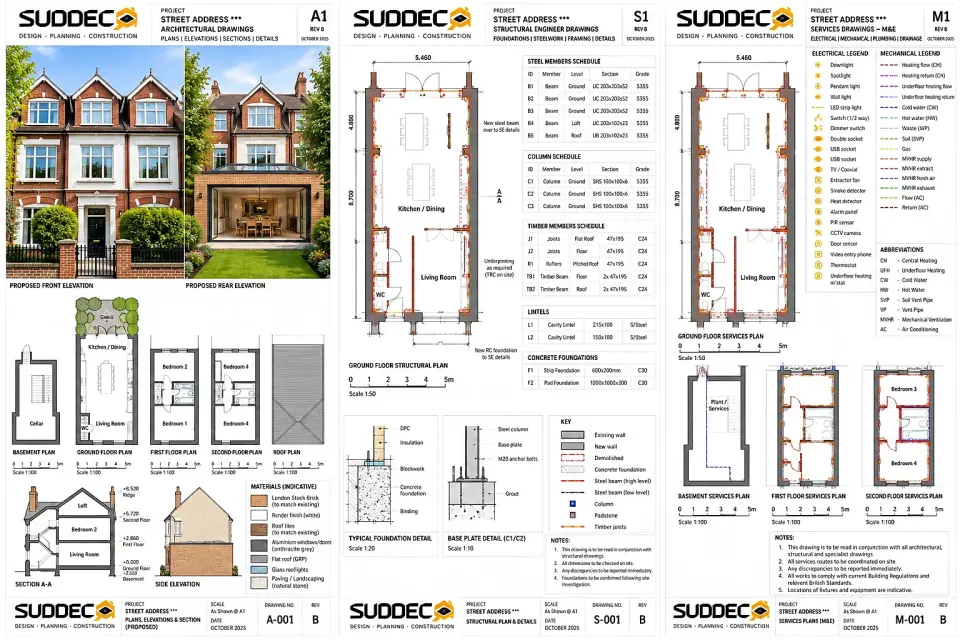
See it for your own home: put in your address and get free concept drawings and an indicative price. Get my free concept → Or see our Planning Applications →
If you are planning a home extension, loft conversion, or major renovation in 2026, understanding the true cost of planning permission is essential. While the headline application fee is straightforward, the full cost picture includes pre-application advice, architectural drawings, building regulations, party wall agreements, and various professional fees that can add thousands to your budget.
In England, a householder planning application costs £206 and a full planning application costs £462. These are the official fees set by the UK government. However, the total cost of obtaining planning permission — including all supporting documentation and professional services — typically ranges from £1,500 to £5,000 for a standard residential project, according to the HomeOwners Alliance.
This guide breaks down every cost you will encounter, explains when you can avoid planning permission entirely, and shows you how to budget accurately for your project.
Table of Contents
- Planning Permission Cost: What You'll Pay in 2026
- Table of Contents
- The Official Planning Permission Fees
- Hidden Costs: The Full Breakdown
- Cost Summary Table: Typical Residential Project
- When Do You Need Planning Permission?
- Permitted Development Rights: How to Save £206
- Planning Permission vs Building Regulations
- How Long Does Planning Permission Take?
- What Happens If Permission Is Refused?
- Location-Specific Variations
- How to Save Money on Planning Costs
- DIY Planning Applications: Are They Worth It?
- How Suddeco Can Help
- Frequently Asked Questions
The Official Planning Permission Fees
The UK government sets standard planning application fees, which are updated periodically. As of 2026, the fees for residential projects in England are:
| Application Type | Fee |
|---|---|
| Householder planning permission | £206 |
| Full planning permission | £462 |
| Outline planning permission | £462 per 0.1 hectare |
| Lawful Development Certificate (existing) | £258 |
| Lawful Development Certificate (proposed) | £103 |
| Prior Approval (larger home extensions) | £103 |
| Discharge of planning conditions | £123 |
| Non-material amendments | £52 |
| Planning appeals | Free |
Source: UK Government Planning Portal, 2026
Householder applications cover extensions, loft conversions, and alterations to a single dwelling. Full applications are required for new builds, conversions of buildings to residential use, or projects that do not qualify as householder applications.
Wales, Scotland, and Northern Ireland have different fee structures. In Scotland, for example, a householder application costs £300, and a full application costs £600. Always check your local council's website for the most accurate fees.
Hidden Costs: The Full Breakdown
The £206 or £462 application fee is just the starting point. Here are the additional costs you should budget for.
Architectural Drawings and Plans
Every planning application requires scaled drawings, site plans, and design and access statements. Architects typically charge £3,750–£7,500 for a typical extension (5–10% of build cost). Architectural technicians charge £1,500–£3,000, and online design services start at £500–£1,500. For a straightforward householder application, budget £1,500–£3,000 for professional drawings.
Pre-Application Advice
Many councils offer pre-application advice, where you submit preliminary plans and receive feedback before formally applying. This is recommended for complex projects. Householder pre-application costs £50–£150, while full pre-application advice runs £150–£500. Written advice alone costs £50–£100. Pre-application advice can save money long-term by identifying issues early.
Building Regulations Approval
Planning permission and building regulations are separate processes. Building control fees range from £200–£1,000 depending on project size. The Full Plans route (£300–£1,000) is recommended for most projects. You can use either your local council's building control team or an approved private inspector.
Structural Engineer Reports
Projects involving wall removal, steel beams, or roof structure changes require structural engineer calculations. Fees range from £500–£2,000. Simple beam calculations cost £300–£600, while a full structural package costs £1,000–£2,500. We recommend budgeting at least £1,000 for structural engineering on a standard extension.
Party Wall Agreements
If your project involves work on a shared wall, excavations within 3 metres of a neighbour's foundations, or alterations to a party wall, you must comply with the Party Wall Act 1996. An agreed surveyor costs £700–£1,500. If neighbours disagree and appoint separate surveyors, costs rise to £1,500–£2,000+. Early communication with neighbours keeps costs down.
Tree Surveys and Environmental Reports
If your property has protected trees (Tree Preservation Orders) or affects wildlife habitats, you may need additional surveys. An arboricultural survey costs £200–£500, and ecological surveys range from £300–£800. These are uncommon for standard householder applications but are critical for rural properties or conservation areas.
Archaeological Assessments
In areas of archaeological interest, councils may require a desktop assessment. This is rare but can add £500–£2,000 to your costs.
Cost Summary Table: Typical Residential Project
| Cost Item | Budget Option | Mid-Range | Premium Option |
|---|---|---|---|
| Planning application fee | £206 | £206 | £462 |
| Architectural drawings | £1,500 | £2,500 | £5,000+ |
| Pre-application advice | £0 | £100 | £300 |
| Building regulations | £200 | £500 | £1,000 |
| Structural engineer | £500 | £1,000 | £2,000 |
| Party wall agreement | £0 | £700 | £1,500 |
| Tree/ecological surveys | £0 | £0 | £500 |
| Total (excluding build) | £2,400 | £5,000 | £10,000+ |
Sources: HomeOwners Alliance; indicative Suddeco estimates
For most homeowners, budgeting £3,000–£6,000 for the full planning and design phase is realistic. This is before a single brick is laid.
When Do You Need Planning Permission?
Not all home improvements require planning permission. Understanding the rules can save you time and money.
You DO need planning permission if: - Your extension exceeds Permitted Development limits - Your property is in a conservation area, AONB, or is listed - You are changing the use of a building or subdividing - Your project involves a flat or maisonette (most PD rights do not apply) - You are building forward of the principal elevation
You do NOT need planning permission if: - Your project falls within Permitted Development Rights - You are making internal alterations only (building regs still apply) - You are replacing like-for-like windows or doors
Permitted Development Rights: How to Save £206
Permitted Development Rights (PDR) allow homeowners to make certain improvements without formal planning permission. For single-storey rear extensions, the key limits are:
- Detached houses: Maximum depth of 4m from the rear wall
- Other dwellings (semi, terraced): Maximum depth of 3m from the rear wall
- Maximum height: 4m
- Maximum eaves height: 3m if within 2m of a boundary
- Materials: Must be similar in appearance to the existing house
- No more than 50% of the original garden area can be covered
For larger home extensions (up to 8m for detached, 6m for other), you can use the Prior Approval process. This costs £103 and requires notifying your neighbours but is cheaper and faster than full planning permission.
Important: Always confirm your PDR status with your local council before starting work. Building without permission can result in enforcement action, including demolition orders.
Planning Permission vs Building Regulations
Many homeowners confuse these two processes. They are separate, and both may be required for your project.
| Aspect | Planning Permission | Building Regulations |
|---|---|---|
| Purpose | Approves design, appearance, and impact on neighbours | Ensures safety, structure, and energy efficiency |
| Cost | £206 (householder) | £200–£1,000 |
| Who issues | Local planning authority | Local council or approved inspector |
| Required for | External changes, extensions, new builds | Most building work, electrics, plumbing |
| Enforcement | Planning enforcement team | Building control |
| Timeframe | 8–13 weeks decision | Inspected at key stages |
You can apply for both simultaneously, but building regulations approval is only granted after planning permission is secured (or if PDR applies).
How Long Does Planning Permission Take?
Standard householder applications should be decided within 8 weeks. Full applications have a 13-week statutory deadline. In practice, expect 8–12 weeks for householders and 12–16 weeks for full applications. Prior Approval and Lawful Development Certificates typically take 6–8 weeks.
If the council requests further information (RFI), the clock stops until you respond, adding 2–4 weeks. Complex applications or busy boroughs may take longer.
What Happens If Permission Is Refused?
If your application is refused, you have three options:
- Resubmit with changes: Address the council's concerns and submit a revised application for another £206.
- Appeal: Submit a free appeal to the Planning Inspectorate. This takes 4–6 months and has a 30–40% success rate for householder appeals.
- Modify your plans: Redesign to fit within Permitted Development or address specific objections.
The best way to avoid refusal is to understand local planning policies before applying. Suddeco's platform shows what has been approved near your address, helping you design a project that aligns with local precedents.
Location-Specific Variations
Planning costs and requirements vary significantly across the UK. Here is what to expect in different regions.
London Boroughs
London boroughs are among the most expensive and restrictive planning environments in the UK. Pre-application fees run £200–£500, design requirements are stricter, and processing times average 10–14 weeks. Additional reports such as daylight/sunlight assessments (£500–£1,500) and transport statements (£300–£800) are more commonly required. Architects in London charge 20–30% more than the national average.
Conservation Areas
If your property is in a conservation area, your Permitted Development Rights are more restricted. Side extensions and two-storey rear extensions usually require planning permission. Conservation Area Consent costs £206 for demolition of unlisted buildings, and heritage statements (£400–£1,000) are often required. Premium materials may add 10–20% to build costs. There are approximately 10,000 conservation areas in England.
Listed Buildings
Listed buildings have the strictest controls. Any alteration affecting the building's character requires Listed Building Consent — even internal work. There is no fee, but professional costs are high: heritage statements (£500–£2,000), historic building surveys (£800–£1,500), and specialist materials can add 20–40% to build costs. England has over 370,000 listed buildings in total.
How to Save Money on Planning Costs
- Use Permitted Development Rights: Avoid the £206 fee and the 8–12 week wait where possible. Our free render service shows you what fits within PDR for your property.
- Use an architectural technician instead of an architect: For straightforward extensions, a technician can produce adequate plans at half the cost.
- Bundle services: Suddeco's Design + Planning package at £2,495 includes planning application, building regulations, structural engineer, and unlimited revisions — often cheaper than sourcing each separately.
- Negotiate party wall agreements early: Speak to neighbours before appointing surveyors. Agreed surveyors cost £700–£1,000 less than two separate surveyors.
- Research local precedents: Applications that align with recently approved local projects are more likely to succeed first time. Suddeco's platform analyses thousands of local planning decisions to show you what works.
DIY Planning Applications: Are They Worth It?
It is possible to submit a planning application yourself using the government's Planning Portal. You will need to draw scaled plans, complete application forms, upload a location plan, and write a Design and Access Statement if required.
The main advantage is saving £1,500–£3,000 on architectural fees. However, poor drawings are the leading cause of delays and refusals. You must also understand local planning policies and neighbour consultation requirements. For most homeowners, the risk of refusal outweighs the savings. A professional set of plans significantly increases your chances of first-time approval. Building regulations plans are separate and usually require a professional.
How Suddeco Can Help
Planning permission costs are just one piece of the puzzle. The bigger challenge is designing a project that will actually be approved — and knowing what your neighbours succeeded in building before you spend a penny on applications.
Suddeco's platform reads your UK address and instantly shows: - What your neighbours have built and got approved - Real designs, real costs, and real planning outcomes - generated concept drawings and priced designs - Whether your project falls within Permitted Development Rights
Start with a free render: Enter your address at Suddeco's free render page and receive an instant visualisation, cost estimate, and planning guidance. No obligation, no credit card required.
In London, our Design-to-Build service is delivered by Suddeco’s own team — design, planning and the build itself, with project management, staged milestone payments and a 12-month warranty.
Knowing your planning costs upfront — and designing a project that aligns with local approvals — is the best way to avoid expensive surprises. Get your free render today.
Frequently Asked Questions
How much is planning permission in 2026?
A householder planning application costs £206 in England. A full planning application costs £462. However, the total cost including drawings, surveys, and professional fees typically ranges from £2,000 to £6,000.
Do I need planning permission for a loft conversion?
Most loft conversions fall under Permitted Development Rights and do not require planning permission, provided they stay within volume limits and do not extend beyond the existing roof plane. However, you will need building regulations approval. Learn more in our extension cost guide.
How long does planning permission last?
Planning permission typically lasts for 3 years from the date of approval. You must begin the development within this timeframe. If you do not start work, the permission expires and you must reapply.
Can I get a refund if my planning permission is refused?
No. The £206 or £462 application fee is non-refundable, even if your application is refused. This is why pre-application advice and professional drawings are a wise investment.
What is a Lawful Development Certificate?
A Lawful Development Certificate (LDC) confirms that your project is lawful under Permitted Development Rights. It costs £103 for proposed work and £258 for existing work. While not legally required, it provides valuable proof if your project is later challenged.
Do I need planning permission for a garage conversion?
Usually not. Converting an existing garage into living space is typically permitted development, provided the work is internal and does not involve enlarging the building. However, building regulations apply, and you may need planning permission if the garage is in a conservation area or if you are creating a separate dwelling.
How much does building regulations approval cost?
Building regulations approval costs £200–£1,000 depending on project size and whether you use your local council or an approved private inspector. A simple garage conversion might cost £200, while a large extension could cost £800–£1,000.
What is Prior Approval?
Prior Approval is a streamlined process for larger home extensions (up to 8m for detached houses, 6m for other dwellings) that exceed standard Permitted Development limits. It costs £103 and requires notifying your neighbours. The council assesses the impact on neighbours rather than the full design.
Do I need a party wall agreement for a rear extension?
You need a party wall agreement if your work involves excavations within 3 metres of a neighbour's foundations, building on or altering a shared wall, or cutting into a party wall. For a simple rear extension that does not touch a shared wall, a party wall agreement may not be required.
How does Suddeco help with planning permission costs?
Suddeco's platform shows you what has been approved near your address, so you can design a project that aligns with local planning precedents. Our Design + Planning package includes the full planning application, building regulations, structural engineer, and unlimited revisions for £2,495 — often cheaper than sourcing each service separately.
See it before you spend a penny
Get a free render of your finished project + a real price — in minutes.
Get your free concept →