Side Return Extension Cost: UK Pricing Guide 2026
Last updated: 21 September 2026
See it for your own home: put in your address and get free concept drawings and an indicative price. Get my free concept → Or see our House Extensions →
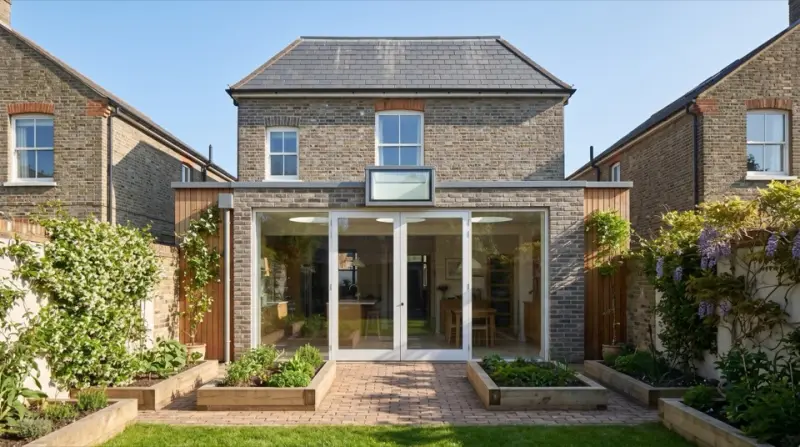
If you live in a Victorian or Edwardian terraced house, that narrow alley running alongside your kitchen is probably the most underused square footage you own. A side return extension fills it in — typically transforming a dark, cramped kitchen into a bright, open-plan kitchen-diner flooded with natural light from a glass roof.
It is one of the most impactful projects you can undertake on a terraced property. But it is also one of the trickier projects to budget for, because the structural work is complex, party walls are almost always involved, and the glass roof that makes the space special does not come cheap.
In 2026, a side return extension costs £2,000–£3,000 per square metre for construction. A typical 10–15 m² project costs £22,000–£45,000 all-in, including construction, VAT at 20%, professional fees, and a 10% contingency. In London, where the majority of side returns are built, expect £28,000–£55,000.
All prices in this guide are inclusive of VAT at 20% unless explicitly stated otherwise. VAT at 20% applies to labour and materials on most residential renovation projects. New-build properties may qualify for zero-rated VAT, but extensions and alterations are standard-rated.
At Suddeco Homes, our online platform reads your UK address and shows you exactly what side return projects have been approved nearby — with real cost data, instant renders, and architect-quality concept drawings. Get your free render here.
Table of Contents
- Side Return Extension Cost per m² (2026)
- Cost Breakdown by Project Size
- Location-Specific Pricing
- What Affects the Cost of a Side Return Extension?
- How to Save Money on Your Side Return Extension
- Side Return vs. Rear Extension: Cost Comparison
- Professional Fees & Hidden Costs
- Planning Permission & Building Regulations
- How Suddeco Helps You Budget Accurately
- Frequently Asked Questions
Side Return Extension Cost per m² (2026)
Side returns sit at the higher end of the extension cost spectrum per square metre. You are building less volume than a rear extension, but the work is more concentrated and structurally demanding.
The main cost drivers per m² are:
- Structural steelwork: Removing the existing rear wall and installing RSJs to create an open-plan space
- Glass roof elements: Roof lanterns, glazed panels, or full structural glass roofs
- Party wall agreements: Surveyor fees and legal requirements under the Party Wall Act 1996
- Higher specification finishes: This is usually your main kitchen space, so finishes tend to be premium
- Restricted site access: Narrow alleys make excavation, material delivery, and waste removal more complex
For 2026, the per-square-metre construction cost is:
| Specification Level | Cost per m² (inc. VAT) | What It Includes |
|---|---|---|
| Standard | £2,000–£2,400 | Basic finishes, standard aluminium windows, roof lantern, mid-range kitchen |
| Mid-range | £2,400–£2,700 | Quality finishes, timber or aluminium glazing, larger roof lantern, good kitchen spec |
| High-end | £2,700–£3,000+ | Bespoke finishes, structural glass roof, Crittall-style frames, premium kitchen |
Quick estimate: A 12 m² side return at £2,500/m² = £30,000 construction cost. Add professional fees, VAT, and 10% contingency, and the total project cost lands at approximately £38,000–£42,000.
Because side returns are typically smaller than rear extensions (10–15 m² versus 20–30 m²), the total cost is lower — but the cost per square metre is higher due to the structural complexity involved.
Cost Breakdown by Project Size
The table below shows total project costs for typical side return extension sizes. These figures include construction, VAT at 20%, professional fees, and a 10% contingency.
| Size (m²) | Description | Minimum Cost (inc. VAT) | Average Cost (inc. VAT) | Maximum Cost (inc. VAT) |
|---|---|---|---|---|
| 8 m² | Narrow side return (kitchen extension only) | £18,000 | £22,000 | £27,000 |
| 10 m² | Standard side return (2.5 m × 4 m) | £22,000 | £27,000 | £33,000 |
| 12 m² | Typical side return (3 m × 4 m) | £26,000 | £32,000 | £39,000 |
| 15 m² | Larger side return (3.5 m × 4.3 m) | £32,000 | £39,000 | £48,000 |
| 20 m² | Side return + small rear element | £41,000 | £50,000 | £61,000 |
Sources: HomeOwners Alliance; indicative Suddeco estimates. All figures inclusive of VAT at 20%.
These totals include:
- Construction labour and materials (inc. VAT at 20%)
- Steel beam installation and structural work
- Glass roof / roof lantern elements
- Planning permission fees (£206 for householder applications — VAT-exempt)
- Building regulations approval (£200–£1,000, inc. VAT where applicable)
- Structural engineer (£500–£2,000, inc. VAT)
- Party wall agreement (£700–£2,000 per surveyor, inc. VAT)
- Architect fees (5–10% of build cost, or Suddeco's fixed-price design packages)
- 10% contingency
Location-Specific Pricing
Side return extensions are most common in London, but Victorian and Edwardian terraced housing stock across the UK means they are also popular in Birmingham, Manchester, Bristol, Edinburgh, and other cities.
London
- Premium: +30–50% on base costs
- Typical cost per m²: £2,500–£3,500 (inc. VAT)
- 12 m² total project: £32,000–£45,000 (inc. VAT)
- Context: London accounts for the majority of UK side return projects. Victorian terraced areas like Clapham, Islington, Hackney, Dulwich, and Streatham are side return hotspots. Party wall agreements are standard, and conservation area constraints are common. Labour rates and demand push costs well above the national average.
South East (Brighton, Oxford, Reading, Guildford)
- Premium: +20–30% on base costs
- Typical cost per m²: £2,400–£3,000 (inc. VAT)
- 12 m² total project: £30,000–£40,000 (inc. VAT)
- Context: Victorian and Edwardian terraced housing in commuter towns. Good builder availability but conservation area restrictions apply in many historic centres. Stamp duty refugees from London have increased demand and prices.
Birmingham & West Midlands
- Typical cost per m²: £2,000–£2,500 (inc. VAT)
- 12 m² total project: £25,000–£33,000 (inc. VAT)
- Context: Areas like Moseley, Harborne, Kings Heath, and Edgbaston have extensive Victorian terraced housing. A competitive builder market keeps costs reasonable compared to the South East.
Manchester & North West
- Discount: -10–15% on base costs
- Typical cost per m²: £1,800–£2,300 (inc. VAT)
- 12 m² total project: £22,000–£30,000 (inc. VAT)
- Context: Victorian terraced areas in Didsbury, Chorlton, Withington, and the city centre. In London, Suddeco’s own team builds it, with a 12-month warranty.
Bristol & South West
- Typical cost per m²: £2,000–£2,600 (inc. VAT)
- 12 m² total project: £25,000–£34,000 (inc. VAT)
- Context: Victorian terraced areas in Clifton, Redland, Southville, and Bedminster. Popular with young professionals and London relocators. Some conservation area constraints, particularly in Clifton.
Edinburgh & Scotland
- Discount: -10–15% on base costs
- Typical cost per m²: £1,800–£2,400 (inc. VAT)
- 12 m² total project: £22,000–£32,000 (inc. VAT)
- Context: Victorian tenements and terraced areas in Marchmont, Bruntsfield, Stockbridge, and Leith. Edinburgh costs are higher than Glasgow due to demand and the prevalence of conservation areas. Note that Scottish planning fees differ slightly from England.
Suddeco tip: Enter your address on our platform and we will show you exactly what side return projects have been approved near you — with real cost data from planning applications. Try it free.
What Affects the Cost of a Side Return Extension?
Side returns have unique cost drivers that do not apply to standard rear extensions. Here is what to watch for when pricing your project.
1. Structural Work (The Big One)
A side return usually requires removing the existing rear wall of your house to create an open-plan kitchen-diner. This is the single biggest cost driver. Expect to budget:
- Steel beam installation (RSJ): £1,500–£3,000 per beam (inc. VAT)
- Structural calculations: £500–£1,000 (inc. VAT)
- Temporary support during construction: £500–£1,000 (inc. VAT)
- Making good internal finishes: £1,000–£2,000 (inc. VAT)
This structural work is why side returns cost more per m² than rear extensions — even though you are building less overall.
2. Glass Roof Elements
Side returns are famous for their glass roofs — bringing daylight into the darkest part of your home. The type of glazing you choose has a significant impact on cost:
- Roof lantern (standard): £1,500–£3,000 (inc. VAT)
- Full glass roof (structural glass): £3,000–£8,000 (inc. VAT)
- Flush rooflights (multiple): £500–£1,500 each (inc. VAT)
- Crittall-style steel frames: +£2,000–£5,000 (inc. VAT)
A well-placed roof lantern can bring in almost as much light as a full glass roof for a fraction of the cost.
3. Party Wall Agreements
If your side return is within 3 metres of your neighbour's foundations — which it almost certainly is — you will need a Party Wall Agreement under the Party Wall Act 1996. Budget for:
- Your party wall surveyor: £700–£2,000 (inc. VAT)
- Neighbour's surveyor (if they appoint one): £700–£2,000 (inc. VAT — you pay)
- Schedule of condition: £300–£500 (inc. VAT)
- Award document: £200–£400 (inc. VAT)
Total party wall costs: £700–£4,000 depending on neighbour cooperation. Cooperative neighbours who agree to use a single agreed surveyor can save you £1,000–£2,000.
4. Foundation Complexity
Side returns often have limited access for excavation, and proximity to neighbouring foundations can require specialist solutions:
- Reinforced foundations: +£2,000–£5,000 (inc. VAT)
- Piled foundations: +£5,000–£10,000 (inc. VAT)
- Underpinning (if neighbour's foundations are affected): +£5,000–£15,000 (inc. VAT)
5. Drainage & Utilities
The side return often contains services that need relocating:
- Shared drains: May need to divert or build over — £1,000–£3,000 (inc. VAT)
- Gas meter relocation: £500–£1,500 (inc. VAT)
- Electrical supply upgrade: £500–£2,000 (inc. VAT)
- Water main diversion: £1,000–£3,000 (inc. VAT)
6. Kitchen & Finishes
Because a side return typically becomes your main kitchen-diner, finish costs are higher than for a utility or playroom extension:
- Kitchen units & worktops: £8,000–£25,000+ (inc. VAT)
- Appliances: £3,000–£10,000 (inc. VAT)
- Underfloor heating: £2,000–£4,000 (inc. VAT)
- Bespoke joinery: £2,000–£8,000 (inc. VAT)
- Feature lighting: £1,000–£3,000 (inc. VAT)
7. Size & Configuration
- Pure side return (fills the alley only): 8–12 m², most cost-effective per project but highest per m²
- Side return + rear extension (wrap-around): 15–25 m², most transformative but highest total cost — see our wrap-around extension cost guide
- Side return + lightwell: Adds a courtyard feel but increases complexity and cost
How to Save Money on Your Side Return Extension
Side returns are never "cheap" — but you can control costs without sacrificing the wow factor. Here are the strategies that work in 2026.
1. Get the Design Right Before You Build
Changes during construction are exponentially expensive on side returns because of the structural complexity. Our Concept Package (£495 or £995, inc. VAT) delivers 3 renders, full plans, and a revision in 48 hours — so every detail is locked down before builders price the work.
2. Use Our platform to See What Neighbours Paid
Suddeco analyses approved planning applications near your address to show you real cost benchmarks for side returns on your specific street. No more relying on London averages that may not fit your local market. Get your free render.
3. Choose a Fixed-Price Design Package
Traditional architects charge 5–10% of build cost — £2,500–£5,000 for a typical £50,000 side return. Our Design+Planning package is a fixed £2,495 (inc. VAT), including planning application, building regulations, structural engineer, and unlimited revisions.
4. Be Strategic About the Glass Roof
- Roof lantern vs. full glass roof: Save £2,000–£5,000
- Standard aluminium frames vs. steel: Save £1,000–£3,000
- Multiple flush rooflights vs. one big glass element: Save £1,000–£2,000
A well-placed roof lantern can bring in just as much light as a full glass roof for significantly less cost.
5. Handle the Party Wall Process Early
- Speak to your neighbours before appointing a surveyor — cooperative neighbours save £1,000–£2,000
- Serve notice early (at least 2 months before work starts)
- Consider appointing an agreed surveyor (one surveyor for both parties) to halve surveyor costs
6. Keep the Kitchen Spec Sensible
A £15,000 kitchen from a quality high-street brand can look just as good as a £30,000 bespoke kitchen. Focus budget on:
- Good worktops (quartz or granite)
- Quality appliances (Bosch, Miele, Neff)
- Soft-close drawers and doors
Save on:
- Bespoke carcasses (standard units are fine)
- Expensive splashbacks (quality tiles look great)
- Over-specified lighting
7. Time Your Build for Off-Peak
- October–February: Builders are less busy, rates may be 5–10% lower
- Avoid: March–September when demand peaks and lead times stretch
8. Consider a Wrap-Around for Better Value
If you are already doing the structural work for a side return, adding a small rear element to create a wrap-around extension gives you far more space for a modest additional cost. A 20 m² wrap-around often costs only 30% more than a 12 m² side return but gives 70% more usable space. See our wrap-around extension cost guide for full pricing.
Side Return vs. Rear Extension: Cost Comparison
| Factor | Side Return | Rear Extension |
|---|---|---|
| Cost per m² (inc. VAT) | £2,000–£3,000 | £1,800–£2,800 |
| Typical size | 10–15 m² | 20–30 m² |
| Total project cost (inc. VAT) | £22,000–£45,000 | £36,000–£87,000 |
| Structural complexity | Higher (removing rear wall) | Lower (usually) |
| Glass roof requirement | Common | Optional |
| Party wall costs | Almost always required | Sometimes required |
| Planning permission | Often PD, sometimes full | Often PD, sometimes full |
| Value added | 10–15% | 15–20% |
| Best for | Terraced houses, kitchen-diners | Detached/semi, larger families |
Bottom line: A side return costs more per m² but less in total because it is smaller. The structural work is the main cost driver. For terraced houses, a side return is often the only viable option — and the transformation is worth every penny.
Professional Fees & Hidden Costs
| Item | Cost (inc. VAT unless stated) | Notes |
|---|---|---|
| Planning permission (householder) | £206 (VAT-exempt) | Required if not permitted development |
| Building regulations | £200–£1,000 | Mandatory for all structural work |
| Structural engineer | £500–£2,000 | Essential for steel beam calculations |
| Party wall surveyor | £700–£2,000 | Required for work within 3m of neighbour's foundations |
| Neighbour's surveyor (if appointed) | £700–£2,000 | You pay if they appoint their own |
| Architect (traditional) | 5–10% of build cost | £2,500–£5,000 for typical £50k side return |
| Building surveyor | £500–£1,500 | Recommended for older properties |
| Contingency | 10–15% of build cost | Essential for unforeseen issues |
| VAT on labour and materials | 20% | Included in all construction costs above; zero-rated VAT only applies to new builds |
Important VAT note: All construction costs shown in this guide include VAT at 20%. If you are a VAT-registered business or developer, you may be able to reclaim VAT. For most homeowner renovations, VAT at 20% on labour and materials is payable and cannot be reclaimed. New-build properties qualify for zero-rated VAT, but extensions and alterations are standard-rated.
Planning Permission & Building Regulations
Permitted Development
Many side return extensions fall under permitted development if:
- Single storey only
- No more than 4 m high
- Width no greater than half the width of the original house
- Materials similar to existing house
- Not on designated land (national parks, AONBs, conservation areas)
Important: If you are in a conservation area (common in Victorian terraced neighbourhoods), permitted development rights are restricted or removed. Check with your local planning authority before assuming PD applies.
Full Planning Permission
You will need householder planning permission (£206, VAT-exempt) if:
- You are in a conservation area
- The extension exceeds permitted development limits
- You are also extending upwards (e.g., adding a rear dormer at the same time)
- Your local authority has an Article 4 Direction removing permitted development rights
Timeline: 8–12 weeks for a decision.
Building Regulations
All side return extensions need Building Regulations approval, covering:
- Structural integrity (especially steel beams)
- Thermal insulation (U-values for walls, roof, floor)
- Fire safety (escape routes, fire doors)
- Ventilation (extractor fans, trickle vents)
- Drainage (connection to existing systems)
Cost: £200–£1,000 depending on your local authority and whether you use a building control private approved inspector.
How Suddeco Helps You Budget Accurately
Side return extensions are notoriously difficult to budget because every project is different — the structural work, the glass roof, the party wall, the kitchen. Suddeco removes the guesswork:
- Enter your address — our platform analyses nearby approved planning applications to show what side return projects actually cost on your street.
- Get a free instant render — see your side return visualised on your actual home, with plans and a cost estimate. Start here.
- Choose your design package — our Concept Package (£495 or £995, inc. VAT) delivers 3 renders, full plans, and a revision in 48 hours. Our Design+Planning package (£2,495, inc. VAT) includes everything for your planning application and building regulations.
- In London, the build itself is done by our own team.
No more wondering "what will this actually cost?" We show you real data from real projects near you.
Frequently Asked Questions
How much does a side return extension cost in 2026?
A side return extension costs £2,000–£3,000 per square metre for construction in 2026, inclusive of VAT at 20%. A typical 12 m² project costs £26,000–£39,000 all-in, including VAT, professional fees, and contingency. In London, expect £32,000–£45,000.
Is a side return extension worth it?
Yes — for terraced houses, a side return is often the single most transformative improvement you can make. It turns a dark, narrow kitchen into a bright, open-plan kitchen-diner. According to the HomeOwners Alliance, a well-designed side return typically adds 10–15% to your property's value.
How long does a side return extension take to build?
A side return extension takes 8–12 weeks on site. Add 4–8 weeks for design and preparation, plus 8–12 weeks for planning permission if required. Total timeline: 4–7 months from design to completion.
Do I need planning permission for a side return extension?
Often no — many side returns fall under permitted development if they are single storey, under 4 m high, and no wider than half the original house width. However, if you are in a conservation area (common in Victorian terraced neighbourhoods), you will likely need full planning permission. Always check with your local authority.
What's the difference between a side return and a wrap-around extension?
A side return fills in the narrow alley beside your house. A wrap-around combines a side return with a rear extension, creating an L-shaped addition. Wrap-arounds cost more overall (£40,000–£80,000) but transform the entire ground floor. See our wrap-around extension cost guide for full pricing.
Why do side returns cost more per m² than rear extensions?
Side returns involve more complex structural work — specifically, removing the existing rear wall and installing steel beams to create an open-plan space. They also typically include glass roof elements and require party wall agreements. The cost per m² is higher, but the total cost is usually lower because side returns are smaller (10–15 m² versus 20–30 m²).
Can I do a side return extension without a glass roof?
Yes, but it is uncommon. The whole point of a side return is to bring light into the centre of your home. Without a glass roof, lantern, or multiple rooflights, the new space can feel dark. A roof lantern (£1,500–£3,000, inc. VAT) is the most cost-effective way to achieve this.
Do I need a party wall agreement for a side return?
Almost certainly yes. If your side return is within 3 metres of your neighbour's foundations or affects a shared wall, the Party Wall Act 1996 applies. Budget £700–£4,000 for surveyor fees, depending on whether your neighbour cooperates or appoints their own surveyor.
How much does a side return extension cost in London?
London side return extensions cost £2,500–£3,500/m² (inc. VAT) due to higher labour rates and demand. A 12 m² project typically costs £32,000–£45,000 all-in. Victorian terraced areas like Clapham, Islington, Hackney, and Dulwich are side return hotspots.
What's the cheapest way to build a side return extension?
Save money by: (1) using a roof lantern instead of a full glass roof, (2) choosing standard aluminium frames over steel, (3) keeping the kitchen spec sensible, (4) getting cooperative neighbours for the party wall process, (5) booking your builder in off-peak season, and (6) using our fixed-price design packages instead of percentage-based architects.
Can I live in my house during a side return extension?
Usually yes, but it is disruptive. The kitchen will be out of action for 6–10 weeks. Most homeowners set up a temporary kitchen in another room (dining room, garage, or utility). The structural work (removing the rear wall) is the most disruptive phase, typically lasting 1–2 weeks.
Should I do a side return or move house?
For many terraced house owners, a side return is more cost-effective than moving. Stamp duty on a £600,000 property is £20,000. Estate agent fees are £6,000–£12,000. Removal costs are £1,000–£3,000. Total moving costs: £27,000–£35,000 — and that is before you factor in the price difference to a larger property. A side return typically costs £25,000–£45,000 and adds permanent value.
How much value does a side return extension add?
A well-designed side return typically adds 10–15% to your property value. For a £500,000 terraced house, that is £50,000–£75,000 in added value. Kitchen extensions at the higher end of the range. The key is matching quality to your local market.
What size side return extension can I build under permitted development?
Under permitted development, a side return must be:
- Single storey only
- Maximum height: 4 m
- Width no greater than half the width of the original house
- Materials similar to the existing house
- Not on designated land (unless permitted development rights apply)
If these limits do not work for your project, you will need householder planning permission (£206).
Can I get a fixed-price quote for a side return extension?
Fixed-price quotes are possible but require detailed plans. We recommend getting our Concept Package first to finalise your design, then requesting fixed-price builder quotes. In London, our Design-to-Build service is delivered by Suddeco’s own team — design, planning and the build itself, with project management, staged milestone payments and a 12-month warranty.
Does VAT apply to side return extensions?
Yes. VAT at 20% applies to labour and materials for side return extensions, as they are classified as alterations to an existing property. All prices in this guide include VAT at 20% unless explicitly stated otherwise. Zero-rated VAT only applies to new-build properties, not extensions or renovations.
Related Articles
- Wrap-Around Extension Cost Guide 2026
- Kitchen Extension Cost Guide 2026
- Rear Extension Cost Guide 2026
- Party Wall Agreement Costs 2026
- Planning Permission Costs 2026
- Suddeco Pricing and Packages
Last updated: 15 January 2026. Cost figures are based on industry data from the HomeOwners Alliance, adjusted for inflation and 2026 market conditions. All prices are inclusive of VAT at 20% unless explicitly stated otherwise. VAT at 20% applies to labour and materials; zero-rated VAT applies only to new-build properties. Prices vary by location, specification, and contractor. Always obtain detailed quotes before committing to a project.
See it before you spend a penny
Get a free render of your finished project + a real price — in minutes.
Get your free concept →