Modern Luxury vs Japandi vs Edwardian Refurb — pick a design language
Last updated: 3 October 2026
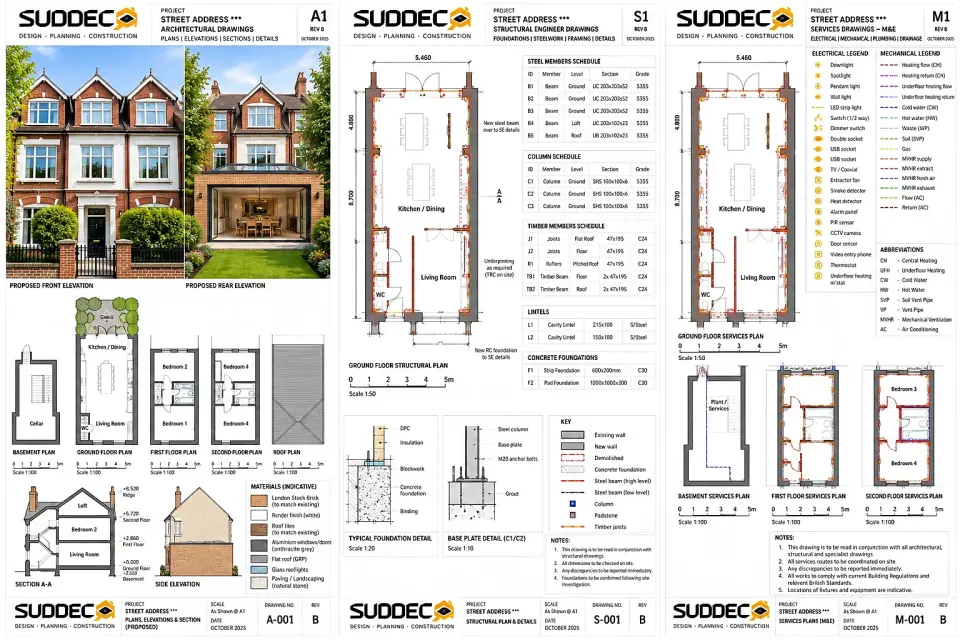
See it for your own home: put in your address and get free concept drawings and an indicative price. Get my free concept →
Most refurbishments do not fail because of one bad decision. They fail because there was never a single design language holding the decisions together. The kitchen is contemporary, the hall is period, the bathroom is hotel-luxury, and the result is a house of good rooms that do not belong to each other.
A design language is simply a set of agreements: which materials appear, how the joinery is detailed, how the lighting behaves, and how much decoration is allowed. Once it is set, hundreds of small choices become obvious rather than agonising.
These are the seven languages we work in most often on London projects, with the palette, materials and cost character of each. For how a language choice affects the whole-house budget, see our renovation cost per square metre guide.
The seven languages
| Language | Palette | Signature materials | Cost character |
|---|---|---|---|
| Modern Luxury | Dark, rich, warm metals | Brushed brass, marble, dark joinery | High |
| Japandi | Neutral, warm, restrained | Oak, linen, ceramic, lime plaster | Moderate |
| Modern Minimalist | Monochrome, cool | Matte black, concrete, glass | Moderate to high |
| Scandinavian | Light, pale, soft | Light oak, white walls, wool | Moderate |
| Edwardian Refurb | Deep, heritage, layered | Cornicing, panelling, period brass | High |
| Contemporary Industrial | Raw, dark, textured | Brick, steel, concrete, black frames | Moderate |
| Warm Contemporary | Soft neutrals, tactile | Microcement, boucle, oak, bronze | Moderate to high |
Modern Luxury
Modern Luxury is dark, rich and confident: brushed brass or bronze, marble or a marble-effect surface, dark stained or painted joinery, and lighting designed in layers with warm accents. It reads as restaurant-quality and it is the language most associated with high-end London refurbishments.
Its cost sits at the top of the range, and not only because of the materials. Mitred stone edges, handleless joinery, shadow gaps, concealed lighting and bespoke metalwork all carry detailing costs. The palette also demands discipline: in a scheme with dark joinery, brass and stone, there is no room for a fourth voice.
It works best in a property that receives good light — a wide Victorian terrace with a bright rear extension, for example. In a small, north-facing room, a rich dark palette absorbs what little light there is, and the room can feel heavy even when beautifully executed.
Japandi
Japandi combines Japanese restraint with Scandinavian warmth: oak, linen, ceramics, lime or clay plaster, and a palette of soft neutrals with almost no metal. It is calm, it ages gracefully, and it is one of the most economical languages to specify because it relies on a small number of honest materials rather than on expensive detailing.
The discipline it requires is in what you leave out. Japandi fails when clutter accumulates, because the language depends on empty surfaces and considered objects. It also depends on light quality: natural materials read best in soft, diffuse daylight, which is exactly what a London room with a north or east aspect offers.
Where it pays to spend is on the things you touch and see closely — the timber worktop, the ceramic basin, the quality of the linen — rather than on the cabinetry structure. A slightly simpler carcass in a beautiful material is more convincing here than a complex build in a cheap one.
Modern Minimalist
Modern Minimalist is monochrome, cool and geometric: matte black, concrete or microcement, glass, and joinery detailed to disappear into the architecture. There are no visible handles, no applied trim and no decoration; the interest comes from proportion, light and surface.
This is a demanding language to build, because everything is visible when nothing is hidden. A shadow gap that varies, a door reveal that is not consistent, or a floor that is not level will show immediately. The cost sits in the labour and the tolerances rather than in the materials, which is why a minimal scheme often costs more than a decorated one with the same palette.
It suits a modern flat, a new-build or an extension, and it suits a household that genuinely keeps surfaces clear. In a family home with a lot of objects, a fully minimal language is a daily battle.
Scandinavian
Scandinavian is the lightest of the languages: white or off-white walls, light oak, pale textiles, wool and soft fabrics, with a focus on comfort and daylight. It is warm without being rich, and it is the most forgiving language in the list for a small or dark London room, because it reflects rather than absorbs light.
Its cost character is moderate, and it is the easiest language to achieve in phases, because the palette is consistent across every element. Light oak appears in the floor, the joinery and the furniture; white appears on the walls and the trim; wool and linen bring in the texture.
The risk is that it can read as generic if the material quality is not there. Scandinavian relies on the real thing — solid or engineered oak, wool, linen — and substitutes look like substitutes. Spend on the floor and the textiles before the decoration.
Edwardian Refurb
An Edwardian or Victorian refurbishment works with what the building already has: cornicing, ceiling roses, panelling, deep skirting, a bay window, period brassware and a colour palette that suits high ceilings and large rooms. Done well, it is the most appropriate language for much of London's housing stock.
Its cost is dominated by labour and making good rather than by materials. Matching an existing cornice profile, replacing a damaged section of panelling, restoring a sash window or repairing original joinery all take skill and time. Where the original fabric survives, restoration is almost always better value than replacement — and it is what gives the property its value.
The mistake is a half-committed period scheme: some cornicing, a modern door and a contemporary kitchen in the same sightline. Where a period language is chosen, it should carry through the trim, the doors, the ironmongery and the lighting, and the modern elements should be introduced deliberately rather than by default.
Contemporary Industrial
Contemporary Industrial draws on exposed brick, black steel, concrete and raw texture, softened with warm lighting and tactile furniture. It is at home in a converted warehouse or a Victorian terrace with a robust rear extension, and it works particularly well where the structure itself is worth showing — a steel frame, an exposed lintel or a brick wall.
The cost character is moderate, because exposed structure removes the need for finishes: no plastering, no boxing in, no decoration. What it demands instead is care with the details that remain — how the steel is painted, how the brick is sealed, how the lighting is fixed to a hard surface — and a genuine tolerance for the rawness, which some households find tiring over time.
Warm Contemporary
Warm Contemporary sits between Minimalist and Japandi: a soft neutral palette, tactile materials, and curved or softened geometry. Microcement, boucle, plaster, oak and bronze or brushed nickel, with lighting layered warmly at 2700 K. It is currently the most requested language in London refurbishments, and it is the most forgiving of detail, because texture and softness hide the tolerances that a fully minimal scheme exposes.
Its cost sits in the range from moderate to high, depending on how much of it is bespoke. Applied microcement and specialist plaster carry real labour. Where the budget is tighter, the language still works using paint, a warm timber and soft textiles.
How to choose — and hold the line
- Let the property lead. A period terrace carries a period language; a modern flat carries a contemporary one.
- Design to the light you have. North-facing rooms need pale, reflective palettes; bright south-facing rooms can carry dark, rich schemes.
- Limit the palette. Three to five primary materials plus one metal finish. Most unresolved schemes use too many.
- Write the agreements down. Metal finish, trim profile, door height, lighting colour temperature — then apply them without exception.
- Choose before pricing. The language drives the labour and detailing cost more than the specification level does.
We apply a chosen language consistently across every room in the scope, render it in your actual property and price the detailing it requires. Our design and build team and our joinery team work to the same palette, and we cover Kensington and Chelsea, Wandsworth and the rest of Greater London.
Frequently asked questions
How do I choose a design language for my home?
Start with the property, not a mood board. A period London terrace carries a period language naturally; a modern flat or extension carries a contemporary one. Then consider the light and how you actually live.
Which design language is most expensive?
Modern Luxury and a full period refurbishment sit at the top, for different reasons — materials in the first case, labour and making good in the second. Japandi and Modern Minimalist are generally the more economical directions.
Can I mix two design languages?
Only where the palette is shared. Japandi and Modern Minimalist combine well. Mixing a period language with a strongly contemporary one in the same room does not, because the two disagree about trim, joinery, lighting and hardware.
How many materials should one scheme use?
Three to five primary materials plus one metal finish. Every additional material has to be justified against the others; repetition of a small palette is what makes a scheme read as designed.
Does a design language affect the build cost?
Yes, often more than the specification level does. Handleless joinery, mitred edges, shadow gaps, concealed lighting and specialist plaster all carry detailing costs that a simpler language avoids.
Related reading
- House renovation cost per square metre
- Kitchen extension cost: the complete 2026 guide
- Design and build service
- Whole-home renovation services
- Projects across Kensington and Chelsea
See your home in each design language
We restyle a finished render of your rooms in seven languages while preserving the geometry and lighting, then price the one you choose.
Get your free concept →