Side Return Extension Cost in London: 2026 Prices
Last updated: 3 October 2026
See it for your own home: put in your address and get free concept drawings and an indicative price. Get my free concept → Or see our House Extensions →
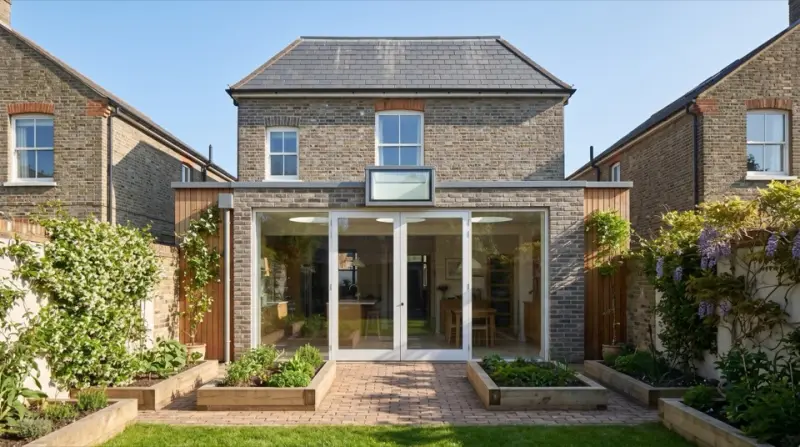
The side return is the most London of all extensions. It exists because Victorian and Edwardian terraces were built with a narrow alley down one side, wide enough for a passage and a drain but useless as living space. Filling it in turns a cramped galley kitchen into a kitchen-diner, and it is usually the cheapest way to gain meaningful ground-floor space on a terraced house.
It is not, however, the cheapest per square metre. A side return in London costs £2,500–£3,500 per m² for construction including VAT, against £2,300–£3,500 for a London rear extension — and because side returns are small, the fixed costs are spread over fewer square metres. A typical 12 m² side return in London costs £32,000–£45,000 all-in, including VAT, professional fees and a sensible contingency. All figures below are indicative 2026 estimates including VAT at 20%.
Side return cost by size in London
| Size | Description | Minimum (inc. VAT) | Average (inc. VAT) | Maximum (inc. VAT) |
|---|---|---|---|---|
| 8 m² | Narrow side return, kitchen extension only | £18,000 | £22,000 | £27,000 |
| 10 m² | Standard side return, about 2.5 m × 4 m | £22,000 | £27,000 | £33,000 |
| 12 m² | Typical side return, about 3 m × 4 m | £26,000 | £32,000 | £39,000 |
| 15 m² | Larger side return, about 3.5 m × 4.3 m | £32,000 | £39,000 | £48,000 |
| 20 m² | Side return plus a small rear element | £41,000 | £50,000 | £61,000 |
Specification moves those numbers further than size does. The range between a standard and a high-end side return of the same footprint is roughly £700 per m²:
| Specification | Cost per m² (inc. VAT) | What it includes |
|---|---|---|
| Standard | £2,000–£2,400 | Basic finishes, standard aluminium windows, roof lantern, mid-range kitchen |
| Mid-range | £2,400–£2,700 | Quality finishes, timber or aluminium glazing, larger roof lantern, good kitchen specification |
| High-end | £2,700–£3,000+ | Bespoke finishes, structural glass roof, steel-framed glazing, premium kitchen |
A quick estimate for a 12 m² side return at £2,500 per m²: £30,000 of construction, plus professional fees, VAT and a 10% contingency, landing at roughly £38,000–£42,000.
Why the per-square-metre rate is high
A side return is small, awkward and structurally demanding. Four things drive the rate:
- Fixed costs over few square metres. Foundations, drainage, roof, scaffolding and site setup cost broadly the same whether the extension is 8 m² or 20 m². Spread over 8 m², they dominate the rate.
- Removing the rear wall. The existing rear wall of the house has to be opened up, which usually means a steel beam. Beam installation runs £1,500–£3,000 per beam, with temporary support during the works at £500–£1,000 and making good internal finishes at £1,000–£2,000. Structural calculations for a side return typically cost £700–£1,100.
- Narrow access. The alley being filled is usually the only route to the rear of the property. Materials and plant have to be handled through the house or over it.
- Complex junctions. A side return ties into the existing house on two or three sides, and the roof has to meet the existing roof and wall properly. Detail work is slow work.
Against that, a side return is smaller than a rear extension, so the total is usually lower. Comparing the two directly: a side return at £2,000–£3,000 per m² covering 10–15 m² totals £22,000–£45,000, while a rear extension at £1,800–£2,800 per m² covering 20–30 m² totals £36,000–£87,000. The side return costs more per square metre and less in total.
Light: the item that makes or breaks a side return
The whole purpose of filling in a side return is to bring light into the middle of the house, and without a glass roof, lantern or rooflights the new space will feel dark. Glazing is therefore not an optional upgrade on this project type — it is the point of it.
| Option | Cost (inc. VAT) | Notes |
|---|---|---|
| Roof lantern, standard | £1,500–£3,000 | The most cost-effective way to get light into the centre |
| Roof lantern, large | £2,000–£5,000 | Better proportions for a 12–15 m² side return |
| Full structural glass roof | £3,000–£8,000 | Maximum light, highest cost; needs careful structural design |
| Flush rooflights | £500–£1,500 each | Multiple units can be cheaper than one large element |
| Steel-framed glazing | +£2,000–£5,000 | Over standard aluminium; popular in period properties |
Choose a lantern over a full glass roof and you can save £2,000–£5,000. Choose standard aluminium over steel-framed glazing and you can save £1,000–£3,000. Neither saving compromises the light, and both are decisions made at design stage rather than on site.
Party wall: almost always applies
On a London terrace, a side return nearly always engages the Party Wall etc. Act 1996, for one of two reasons. Either the new structure ties into the shared side wall, or the foundations are excavated within 3 metres of the neighbour's foundations and go deeper than theirs. Notice must be served at least two months before excavation or one month before work to the wall.
| Item | Cost (inc. VAT) |
|---|---|
| Your surveyor, agreed appointment | £700–£2,000 |
| Agreed surveyor, central and west London | £1,500–£2,500 |
| Neighbour's surveyor, if they appoint one | £700–£2,000, which you pay |
| Schedule of condition | £300–£500 |
| Two-surveyor scenario, total | £2,800–£6,000 in London |
| Third surveyor, if required | £500–£1,500 |
Total party wall exposure typically lands between £700 and £4,000. Cooperative neighbours who agree to a single agreed surveyor save £1,000–£2,000, which makes an early conversation with next door one of the highest-value things you can do on this project.
Drains and services
London terraces often have a shared drain running through the side return, and the alley is where the manhole sits. This is frequently the least anticipated cost on the project:
- Diverting or building over a shared drain: £1,000–£3,000, plus a build-over agreement where a public sewer is affected.
- Gas meter relocation: £500–£1,500.
- Electrical supply upgrade: £500–£2,000.
- Water main diversion: £1,000–£3,000.
- Reinforced foundations where the excavation is close to a neighbouring structure: +£2,000–£5,000. Piled foundations, if ground conditions demand them: +£5,000–£10,000.
If any of these are likely, they should be identified at survey stage. Discovering a shared drain under the new footprint after the slab has been poured is the most expensive kind of surprise.
Planning and building regulations
Many London side returns fall within permitted development as part of a single-storey rear extension, within the standard limits: no more than 3 metres beyond the original rear wall for a terraced or semi-detached house, 4 metres for detached, single storey, no more than 4 metres to the eaves, and materials matching the existing house. Because side returns commonly sit alongside a rear extension, the two are usually assessed together against the same limits.
Where the scheme exceeds those limits, or the property is in a conservation area or covered by an Article 4 direction, householder planning permission is needed at £206, with decisions typically in 8–12 weeks. Larger rear extensions can use Prior Approval at £103, determined in around 6–8 weeks. A Lawful Development Certificate for proposed works costs £103 and provides useful proof if permitted development is later questioned.
Building regulations approval is always required. In London, budget £600–£1,000 through the borough or £900–£1,200 via a private approved inspector. For a side return the relevant parts are: the structure, including the steel beam and its bearings; the drainage alterations; thermal performance to Part L, which matters most where large areas of glazing replace solid wall; ventilation; and electrical certification. Expect three to five inspections — foundations, damp-proof course, structural first fix, drainage and completion — at £80–£250 per visit beyond those included.
Timeline
A side return typically takes 8–12 weeks on site. Groundworks and the steel installation are the two pinch points, and drainage diversion can add a week if a build-over agreement is needed. Before construction, allow 2–4 weeks for measured drawings, 8–12 weeks for a planning decision where required, and up to two months for party wall notice periods if a neighbour dissents. A side return started in spring is usually finished by mid-summer.
Most homeowners stay in the property. The kitchen is normally out of action for the middle stretch, so a temporary arrangement and a realistic view of the disruption are worth planning for.
Value and where to spend
A well-designed side return typically adds 10–15% to the value of a terraced house — less than a full rear extension, but achieved for less money and with far less disruption. On a £500,000 terraced house, that is £50,000–£75,000 of added value.
Spend on: the light (a good lantern or glass roof), the structural work, and the kitchen layout. Save on: glazing frames over structural glass, multiple flush rooflights instead of one large glass element, and standard aluminium instead of steel-framed units. A quality £15,000 kitchen can look as good as a £30,000 one when the layout and lighting are right.
Two further habits protect the budget. First, settle the design before builders price the work — variations on site carry London labour rates and a disruption premium. Second, budget for the drains and the party wall from the beginning rather than treating them as contingencies; on this project type they are near-certainties, not risks.
Our free concept service checks your address, the planning position and what has been approved on neighbouring streets, and produces concept drawings with an indicative cost. The Concept package provides measured drawings and renders at £995. Design + Planning, covering the planning application, building regulations drawings and structural engineering, is £2,495. Design to Build, where Suddeco carries out the work at a fixed quote, starts at £4,500. We work across Greater London only.
Frequently asked questions
How much does a side return extension cost in London?
A typical 12 m² side return costs £32,000–£45,000 all-in including VAT, professional fees and contingency. Construction runs at £2,500–£3,500 per m². An 8 m² side return costs £18,000–£27,000 all-in. These are indicative 2026 estimates.
Why is a side return more expensive per square metre than a rear extension?
Fixed costs are spread over fewer square metres, the rear wall has to be opened up with a steel beam, access down the alley is usually the only route to the rear, and the roof and walls meet the existing house on two or three sides. The rate is higher, but the total is usually lower.
Do I need planning permission for a side return in London?
Many fall within permitted development as part of a single-storey rear extension: no more than 3 metres beyond the original rear wall for a terrace or semi, 4 metres for a detached house, and materials matching the existing house. Conservation areas and Article 4 directions restrict this. Householder permission costs £206.
Does a side return always need a party wall agreement?
Almost always on a London terrace, because the structure ties into the shared side wall or the foundations go deeper than the neighbour's within 3 metres. Budget £700–£2,000 for an agreed surveyor, £1,500–£2,500 in central and west London, or £2,800–£6,000 if two surveyors are appointed.
How much does glazing add to a side return?
A standard roof lantern costs £1,500–£3,000 and a large one £2,000–£5,000. A full structural glass roof runs £3,000–£8,000, and steel-framed glazing adds £2,000–£5,000 over standard aluminium. Glazing is essential on a side return, not optional.
What are the hidden costs on a side return?
Drainage is the big one: diverting or building over a shared drain costs £1,000–£3,000, plus a build-over agreement. Mains and meter relocations add £500–£3,000 each, and reinforced or piled foundations add £2,000–£10,000 where ground conditions or neighbouring structures demand them.
How long does a side return extension take to build?
Typically 8–12 weeks on site. Groundworks and the steel installation are the pinch points, and a drainage diversion can add a week. Add 2–4 weeks for drawings, 8–12 weeks for planning where required, and up to two months of party wall notice periods.
How much value does a side return add in London?
A well-designed side return typically adds 10–15% to the value of a terraced house, for considerably less money and disruption than a full rear extension. On a £500,000 terraced house that is £50,000–£75,000 of added value.
See your side return before you build it
Get a free render of your filled-in side return plus an indicative London price, including the light strategy.
Get your free concept →