Soft-close hinges and drawer runners — basic / mid / premium tier (what to spec)
Last updated: 3 October 2026
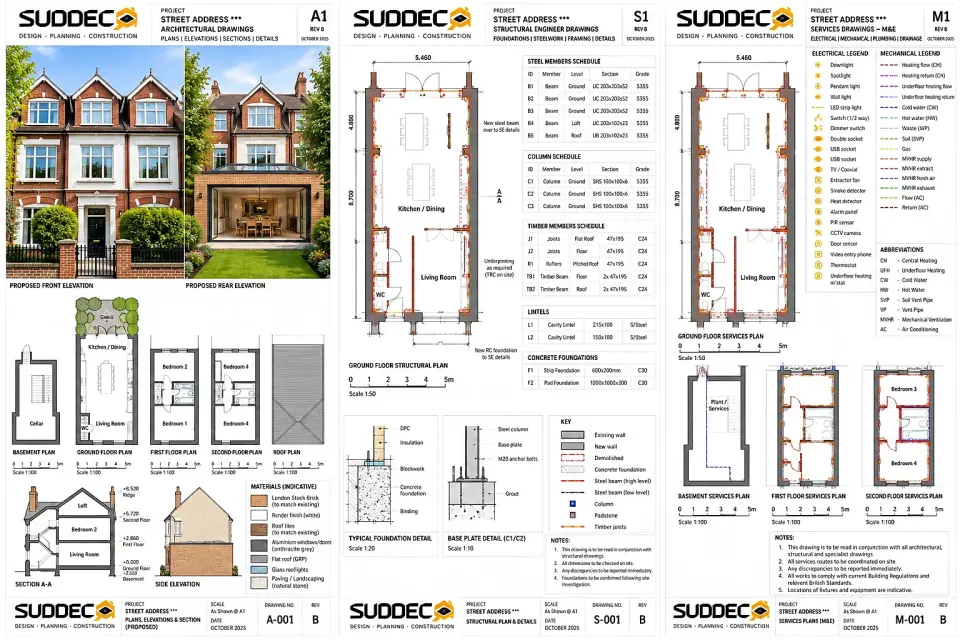
See it for your own home: put in your address and get free concept drawings and an indicative price. Get my free concept →
Hardware is the most under-specified part of a kitchen and the part that determines how the room feels after two years. Doors and worktops get chosen carefully; hinges and runners get whatever came in the box.
The result is predictable. A drawer that ran smoothly in the showroom starts to sag, a door stops closing flush, and the kitchen begins to feel tired long before the surfaces have aged at all. None of this is expensive to prevent — it is simply a matter of choosing a tier deliberately.
This guide sets out what each of the three tiers actually is, the warranty and load figures that identify them, and where the money is genuinely worth spending. For where the hardware allowance sits in the cabinetry budget, see our kitchen extension cost guide.
The three tiers
| Tier | Runner | Typical warranty | Right for |
|---|---|---|---|
| Basic | Zinc-alloy soft-close, part extension | 1–3 years | Rental and buy-to-let |
| Mid | Steel ball-bearing soft-close, part or full extension | 5–10 years | Owner-occupied refurbishment |
| Premium | Full-extension undermount, soft-close | 10 years or more | Kitchens used daily |
The warranty is the most useful proxy when comparing quotes. A supplier who will only offer a one or three year warranty on a runner is telling you what they expect the product to do.
Basic tier: zinc-alloy soft-close
The basic tier is a lightweight soft-close runner, usually zinc-alloy, often supplied pre-fitted to off-the-shelf carcasses. It is genuinely fine for a rental property or a short-hold flat: the mechanism is inexpensive to replace, and the tenant turnover will not test it hard.
The limitation is material. Zinc-alloy components wear faster under load, the soft-close damper loses its resistance, and a drawer that carries pans will begin to sag and to run unevenly. In a family kitchen used daily, failure typically shows up somewhere between eighteen months and three years. That is not a defective product — it is a product doing what its specification promised.
If you are specifying basic tier, do it deliberately: choose it for the rooms and uses where it will not be stressed, and do not fit it to a pan drawer and hope. Where the budget is genuinely constrained, a mixed specification — basic for light-use units, mid for the working drawers — is far better than mid everywhere at a lower quality.
Mid tier: steel ball-bearing soft-close
The mid tier is the right answer for an owner-occupied refurbishment. These runners use steel ball bearings, which carry load far better and wear much more slowly than a plain slide, and they are available in soft-close, part-extension and full-extension versions.
Expect a five to ten year warranty and a rated load of around 25–30 kg per pair in this tier. That is comfortably more than a domestic pan drawer holds, which means the runner is not working at its limit in normal use — the single most important factor in how long it lasts.
Choose full extension for any drawer where you need to see or reach the whole contents: pan drawers, cutlery drawers, deep storage under an oven. Part extension is acceptable for drawers that hold shallow or rarely used items. This is the one place where the difference between part and full extension is noticed every day.
Premium tier: full-extension undermount
The premium tier is a full-extension undermount runner, where the mechanism is hidden beneath the drawer box rather than on its sides. Ten years or more of warranty is the norm, load ratings are higher, and the movement is smoother and quieter because the mechanism is larger and better protected.
Undermount runners also look better when a drawer is open, because there is no visible hardware down the side of the box. In a kitchen where drawers are open for much of the working day, that is a genuine visual improvement rather than a detail.
The premium tier is worth it on the drawers that get used most: two or three pan drawers, a cutlery drawer, a bin pull-out and a deep larder drawer. It is not worth it on a drawer that holds table linen and is opened twice a month. Upgrading those three or four working drawers typically adds a modest amount to the cabinetry package and changes the daily experience of the kitchen more than any door finish.
Never mix tiers within one run
Mixing hardware tiers in a single run is immediately noticeable. A lighter door or drawer, or one on a different runner, closes with a different sound, sits fractionally differently and drifts out of alignment sooner. The kitchen tells you which one it is every time it is used.
This is the same principle that applies across the whole property: one runner tier within a run, one hinge type within a room, one metal finish across all the ironmongery. Consistency is what makes good joinery read as good joinery, and it is achieved at specification stage rather than by selecting the best components for each individual unit.
Where a mixed specification is genuinely necessary — for budget reasons, or because an appliance housing dictates a different runner — physically separate the tiers so the difference is not read side by side.
Concealed-fix hinges from mid tier upward
Hinges matter as much as runners. A concealed-fix hinge is adjustable in three directions after hanging, which is what allows door gaps to be set consistently across a run and re-adjusted later when a door moves with the seasons. It also leaves no screw heads visible on the door face or the cabinet frame.
Concealed-fix hinges belong on mid specification and above. Exposed-screw hinges are acceptable on basic specification, or where a period property genuinely calls for a visible ironwork detail — in which case the hinge should be a deliberate feature in the same finish family as the handles, not a bright plated hinge from a fittings pack.
Allow three hinges on a standard height unit door and four on a tall or heavy door. Tall larder doors in particular are often hung on three hinges when four are needed, which is why tall doors are the first to twist.
How to check the hardware specification
- Ask for the runner model and warranty in writing. "Soft-close runners" is not a specification; a model number and a warranty period is.
- Open the deepest drawer in the showroom and pull it fully out. If it stops halfway, it is part extension, whatever the label says.
- Put weight in it. Press down on the front of an open drawer. A well-specified runner will feel solid with minimal flex.
- Check the drawer box, not just the runner. A thin stapled box will fail around a good runner and waste the upgrade.
- Check the hinge adjustment. A concealed-fix hinge has visible adjustment screws on the mechanism when the door is open; a fixed hinge does not.
We specify hardware tier as a visible sub-line in every joinery and cabinetry quote, so you can see exactly what you are getting and what an upgrade costs. Our kitchen team and our joinery team both build to the same standard, and we work across Wandsworth and the rest of Greater London. For the wider whole-house budget, see our renovation cost per square metre guide.
Frequently asked questions
How long should soft-close drawer runners last?
A basic zinc-alloy runner commonly lasts around eighteen months to three years in a family kitchen; mid-tier steel ball-bearing runners five to ten years; premium undermount runners ten years or more. The warranty is a good proxy — 1–3 years is basic, 5–10 mid, 10+ premium.
Is soft-close worth paying for?
Yes. Soft-close stops doors and drawers slamming, which is the main cause of hardware wear and of doors drifting out of alignment. What is not worth paying for is soft-close built from lightweight components.
What is a concealed-fix hinge?
A hinge adjustable in three directions, with no visible screws on the door face or frame. It allows door gaps to be set precisely and re-adjusted later. It belongs on mid specification and above.
Can I mix hardware tiers in one kitchen?
You can, but the difference is obvious — one drawer closes differently and drifts sooner. Keep one tier across a run, and ideally across the whole room. Where a mix is unavoidable, separate the tiers physically.
Where should I spend more on kitchen hardware?
On the items used most: pan drawers, cutlery drawers, bin pull-outs and the doors you open every day. Upgrade those to premium and use mid-tier hardware elsewhere. Premium runners in a rarely opened drawer is the wrong way round.
Related reading
- Kitchen extension cost: the complete 2026 guide
- House renovation cost per square metre
- Kitchen design and installation
- Fitted wardrobes and bespoke joinery
- Projects across Wandsworth
See the hardware tier in your quote
We price hinges and runners as visible sub-rows, so you can see exactly what each tier adds before you commit.
Get your free concept →